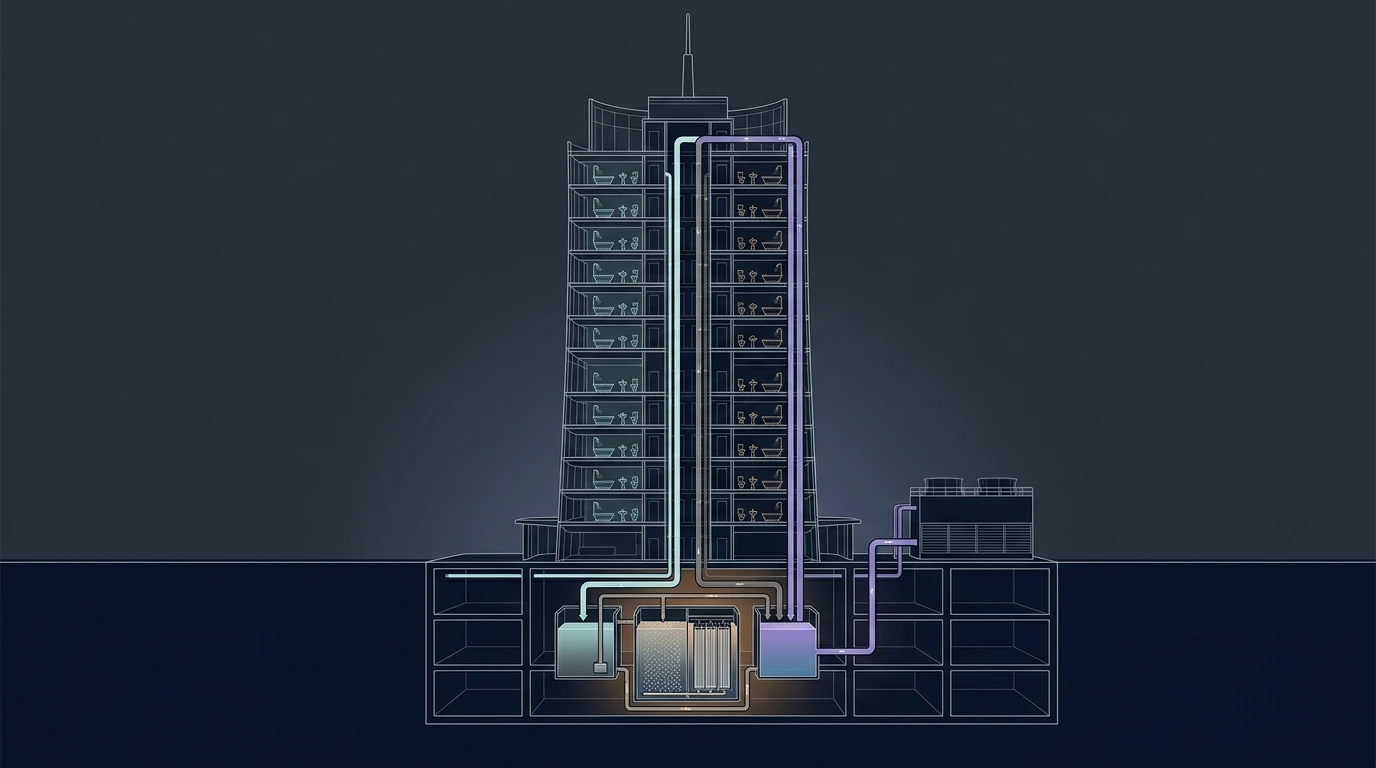
Water reuse in a tower is usually presented as a sustainability gesture and designed as an afterthought, which is why so many systems end up either starved or overflowing. It is actually a matching problem: greywater from showers, basins and laundry is roughly twice the volume that toilet flushing can absorb, so a scheme designed to flush WCs throws half its source away — while the cooling towers next door are drinking 1,800 m³ a day that the same greywater could only cover 13 % of. Get the source and the sink matched and reuse is one of the strongest business cases in a Gulf tower. Get them mismatched and you have built a treatment plant that spends its life bypassing to drain.
1 · Start with the water balance, not the technology
Every reuse scheme is defined by three quantities, and the design is simply the smallest of them:
- What is available. Greywater — showers, baths, basins, laundry — is typically 50–55 % of indoor demand. Kitchen waste is usually excluded as it is heavily loaded with fats and food solids and belongs with blackwater.
- What can use it. WC flushing is around 28 % of indoor demand. Irrigation is seasonal and often small on a tower site. Cooling tower makeup is in a different league entirely and is the sink that changes the arithmetic.
- When each happens. Greywater arrives in a morning and evening peak; flushing follows occupancy; cooling tower makeup peaks in the afternoon and runs all night in summer. The mismatch in time is what sizes the storage.
Two other sources are usually forgotten and are worth more than they look in this climate: air-handling condensate, which in a humid Gulf summer can be substantial and is nearly distilled water, and groundwater from permanent dewatering, covered in deep basement dewatering, which in a permeable site can exceed every other source combined.
2 · Interactive: source, sink and the match between them
A 2,000-person tower produces 238 m³/d of greywater against a WC flushing demand of only 123 m³/d — so a flush-only scheme discards nearly half its source, and the treatment plant is sized by the sink, not the source. Now bring the cooling plant in: 50 MW of rejection needs 2,400 m³/d of makeup, which the greywater covers only 10 % of. That is the design conclusion in both directions: in a water-cooled tower the sink is effectively unlimited, so collect every drop you can and treat to the quality the towers need; in a district-cooled or air-cooled tower the sink is small, so size on flushing plus irrigation and do not over-collect. Note also that greywater into cooling towers demands a higher treatment standard than flushing — you are creating an aerosol.
3 · Treatment: to what standard, and why that decides everything
Reuse standards differ sharply by end use, and the required quality drives the entire plant selection:
- Irrigation, sub-surface. The least demanding. Screening, biological treatment and disinfection are typically sufficient.
- WC flushing. Human contact is credible, so turbidity, BOD and residual disinfectant limits tighten, and colour and odour become a user-acceptance issue as much as a health one. A membrane bioreactor (MBR) is the usual answer because it produces a consistent, low-turbidity effluent in a small footprint.
- Cooling tower makeup. The most demanding, and the one most often underestimated: the tower creates a breathable aerosol, so microbiological control is paramount, and the water chemistry must also suit the treatment programme — nutrients such as phosphorus and nitrogen left in reclaimed water feed biofilm and directly undermine the Legionella control discussed in cooling towers.
- Never for potable use, and physically impossible to cross-connect: separate pipework, distinct colour coding and marking, no shared valves or hose points, and backflow protection at every interface.
A 238 m³/d plant at an 8-hour retention time is a 79 m³ bioreactor, and with raw and treated buffers the total wet volume is around 258 m³ — roughly 86 m² of plant room at 3 m depth, plus the membranes, blowers, dosing and controls. That is a real basement room that must be found early, ventilated, drained, acoustically treated and given odour control, and it needs a maintenance route for membrane replacement. The tank sizes are dominated by the buffers, not the reactor — which is the practical point: storage is what makes the profiles match, and skimping on it produces a plant that alternately starves and overflows.
4 · Interactive: does it actually pay?
Reuse has a real operating cost — energy for aeration and membranes, membrane replacement, chemicals and skilled attendance — and a scheme justified on the water tariff alone can be a net loss if that cost is ignored.
At a combined 9 per m³ tariff and a realistic 3 per m³ operating cost, a 238 m³/d scheme nets about 0.52 M a year against roughly 1.07 M of capital — a simple payback near 2.1 years, which is genuinely good. Now drag the operating cost up to 6 and the tariff down to 4: the net saving collapses and the payback disappears entirely. The result is almost entirely a function of the local tariff, and in jurisdictions where water is heavily subsidised a reuse scheme has to be justified on resource grounds, on a green rating credit, or on resilience — not on payback. Say which one, in the design report, rather than presenting a payback that depends on a subsidy decision.
5 · Dual pipework — where these schemes actually fail
- Cross-connection is the catastrophic failure mode, and it happens during fit-out and alteration rather than at construction. Distinct pipe colour and continuous marking, different connection types where practicable, no shared valves, hose points or drain-downs, and a documented commissioning cross-connection test.
- Label the outlets. Non-potable outlets marked in the languages the building's users and maintainers actually read, with a permanent sign not a sticker.
- Design the top-up carefully. The treated water tank needs a potable top-up for when the reuse plant is down — and that top-up is the single most likely cross-connection in the whole building. It must be through a type AA or AB air gap, never a check valve.
- Give the plant a bypass to drain that is automatic on out-of-spec water quality, with the reuse system reverting to potable top-up. A plant that cannot fail safely will be switched off manually and left off.
- Monitor quality continuously — turbidity and residual disinfectant as a minimum, interlocked to the bypass, trended and alarmed.
- Remember the reuse riser has its own pressure zoning problem, exactly as in domestic water supply — a third set of zones, tanks and PRVs, which is a real cost the business case must carry.
6 · Installation & execution tricks
- Find the plant room at concept. 250 m³ of tankage plus plant is a basement room; it cannot be squeezed in later, and it needs drainage, ventilation, odour control, acoustic treatment and a membrane replacement route.
- Separate greywater drainage from the start. Collecting greywater means a second drainage stack system from every bathroom — decided at the earliest layout stage, impossible to retrofit, and a real coordination load in the riser shafts.
- Exclude kitchens deliberately and physically, and put a grease interceptor on anything that might connect anyway.
- Design for the commissioning gap. A reuse plant with no flow during a long fit-out has no biology; plan seeding, a temporary feed, or a start-up sequence timed to occupancy.
- Trend the reuse fraction from day one — the percentage of non-potable demand actually met. It is the one number that tells you whether the scheme is working, and it is almost never measured.
- Meter everything: raw collected, treated produced, reused delivered, potable top-up and bypass to drain. Without all five the balance cannot be closed and faults hide.
- Write the operator competence into the O&M. An MBR is a small wastewater treatment works inside a luxury building; it needs someone who understands biology, not just a facilities technician with a checklist.
7 · The design & installation checklist
- Build the water balance first — source, sink and timing — and size on the smaller of source and sink.
- Identify the real sink. With water-cooled plant it is effectively unlimited; without it, flushing and irrigation cap the scheme.
- Set the treatment standard by end use, with cooling tower makeup the most demanding.
- Include condensate and dewatering as sources — both are cleaner than greywater.
- Size the buffers, not just the reactor — storage is what matches the profiles.
- Cost it honestly with operating cost included, and state the real justification if the payback does not stand alone.
- Design dual pipework against cross-connection, with an air-gapped potable top-up.
- Provide automatic bypass on out-of-spec quality, interlocked to continuous monitoring.
- Meter all five streams and trend the reuse fraction.
References & standards
- WHO Guidelines for the Safe Use of Wastewater, Excreta and Greywater, and Water Safety in Buildings — health-based targets for reuse applications.
- BS 8525 — Greywater systems: design, installation, water quality and maintenance; and BS 8515 for rainwater harvesting.
- NSF/ANSI 350 — onsite residential and commercial water reuse treatment systems; and the International Plumbing Code / Uniform Plumbing Code non-potable water provisions.
- ISO 30500 and ISO 16075 — non-sewered sanitation and guidelines for treated wastewater use for irrigation.
- Saudi regulations on treated sewage effluent reuse and the Saudi Building Code SBC 701 plumbing provisions, including non-potable distribution and marking.
- Estidama Pearl, Mostadam and LEED water efficiency credits — the rating requirements that often drive these schemes.
- ASHRAE Handbook — HVAC Applications, Water Treatment chapter, and ASHRAE 188 — implications of reclaimed water for cooling tower chemistry and Legionella risk.
- AWWA M14 — Backflow Prevention and Cross-Connection Control, for the potable top-up and interface protection.