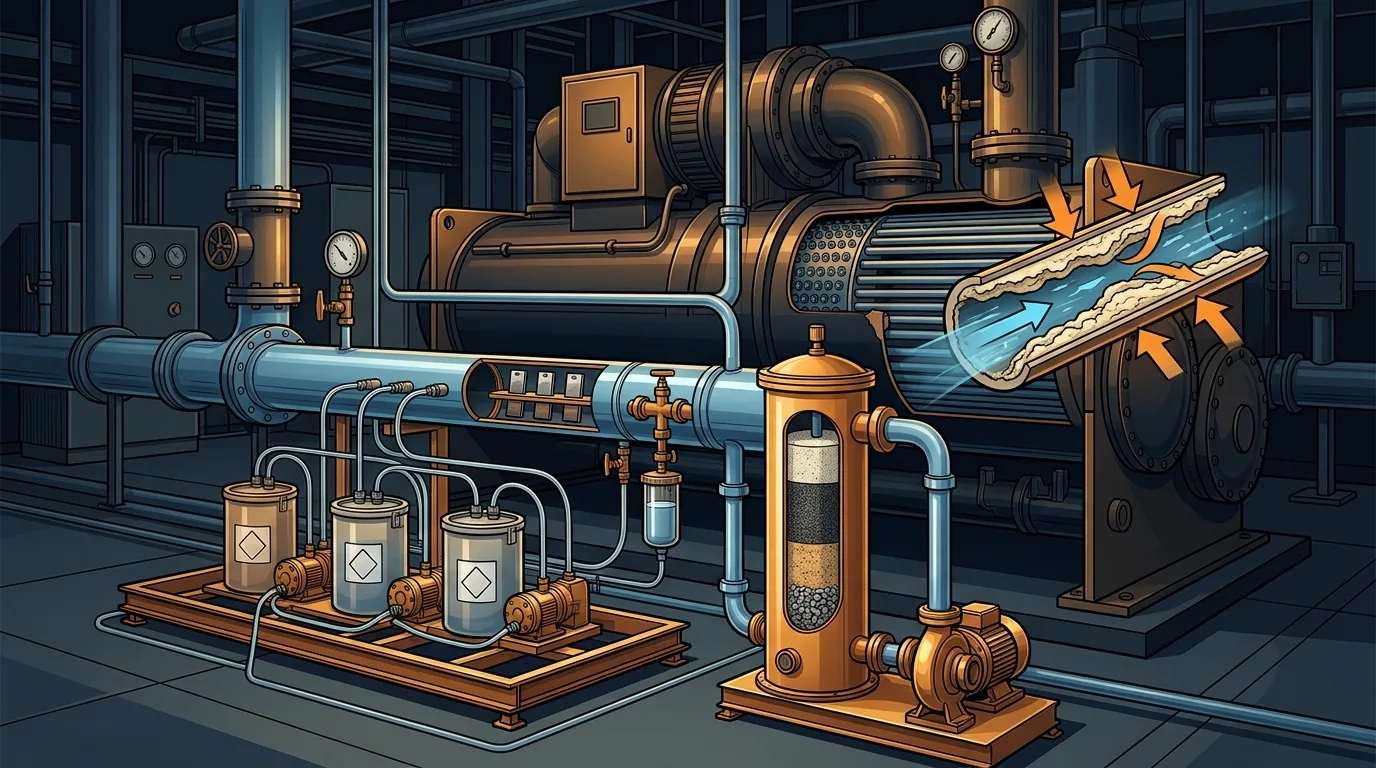
Water treatment is the last line item in the tender, the first thing value-engineered out, and the only system in the building whose neglect degrades every other system simultaneously. A millimetre of scale on a condenser tube is not a maintenance issue — it is a 25 % increase in chiller power for the same cooling, invisible on every gauge, arriving so slowly that nobody notices the building got worse. Meanwhile the corrosion nobody measured is taking wall thickness off risers that were designed to last sixty years and are buried in a core that will never be opened.
1 · Three problems, one system
- Scale. Calcium and magnesium salts precipitate on the hottest surfaces — condenser tubes, heat exchanger plates. Scale is an excellent insulator, and it lands exactly where heat transfer matters most.
- Corrosion. Oxygen, dissolved solids, pH excursions and galvanic couples remove metal. In a closed chilled-water system the oxygen should be consumed early and the system should then be almost inert; in an open condenser system corrosion is continuous and must be inhibited chemically for the whole life of the plant.
- Biofouling. Biofilm insulates like scale, shelters corrosion beneath it, and in an open cooling tower is a public-health matter — the Legionella control discussed in cooling towers. A biofilm a fraction of a millimetre thick has a thermal resistance comparable to several millimetres of scale.
These interact. Scale shelters bacteria; biofilm creates the local chemistry that drives pitting; corrosion products become the suspended solids that foul the exchangers. Treating one and ignoring the others does not work, which is why a treatment programme is a system rather than a dosing pump.
2 · Interactive: what fouling actually costs
A fouling layer adds a thermal resistance in series with the tube wall. The temperature penalty it produces is simply that resistance multiplied by the heat flux, and the chiller pays for it in condensing temperature:
Half a millimetre of scale — a deposit you would describe as "a bit of a film" — raises the condensing approach by 5 K and the chiller's power by 12.5 %. On a 1,200 kW compressor that is 150 kW, continuously, for as long as the scale is there. Take it to a full millimetre and the penalty is 25 %. Now compare that with the cost of a treatment programme, which is a rounding error beside it. Note the conductivity slider: silica scale and biofilm conduct far worse than calcium carbonate, so a thin biofilm can cost more than a much thicker layer of hard scale — which is why microbiological control is an energy measure and not only a health one.
3 · Interactive: side-stream filtration
Suspended solids — airborne dust scrubbed out by the cooling tower, corrosion products, biological debris — settle in low-velocity areas, foul exchangers and shelter bacteria from biocide. Filtering the whole flow is uneconomic; filtering a side stream continuously is not.
A 5 % side stream on a 200 L/s condenser circuit is a 10 L/s filter turning the system over roughly twice a day — enough to hold suspended solids down and to keep biocide effective, for about 3.8 kW. The cut point matters as much as the flow: a centrifugal separator removes sand and heavy grit but passes the fine particles that actually foul plates and shelter biofilm, so a separator is a pre-filter, not a filtration strategy. Take the suction from the point where solids collect — the tower basin sweep or the sump — rather than from a convenient tee on a clean main, which filters water that was already clean.
4 · Interactive: corrosion and asset life
At a respectable 2 mpy the uniform wall loss uses the whole 3 mm allowance in about 59 years — apparently fine for a 60-year building. Apply a pitting factor of four, which is entirely normal under deposits or where microbiologically influenced corrosion is present, and the first perforation arrives in 15 years. That gap is the reason coupon monitoring alone is not enough: an average rate says nothing about the deepest pit, and it is the deepest pit that floods the floor. Measure corrosion with coupons, but control it by removing what makes pits — oxygen, deposits and biofilm — rather than by watching a number.
5 · Closed systems: different problem, worse neglect
Chilled-water and heating circuits are closed, so the received wisdom is that they need little attention. That is true only if they were commissioned properly and have stayed closed:
- Every make-up event is a fresh dose of oxygen. A closed system that is quietly topping up is not closed — it has a leak, and it is being continuously re-oxygenated. Meter the make-up and alarm on abnormal consumption; it is the single most useful instrument on a closed system and it costs almost nothing.
- Pre-commission cleaning is not optional. New systems contain mill scale, flux, jointing compound, swarf and construction debris. Flushing, chemical cleaning and passivation to a stated standard, with a cleanliness acceptance test, is what determines whether the system spends its life clean or spends it fouling.
- Dose the inhibitor and then prove it. Inhibitor depletes; test it at least twice a year and re-dose. A closed system dosed once at handover and never checked is an untreated system after five years.
- Provide dosing pots, sample points and coupon stations on every closed circuit, positioned where someone can actually reach them. Their absence is why the testing never happens.
- Watch dissimilar metals. Steel, copper, stainless and aluminium in one circuit is a galvanic problem that inhibitors must be selected to cover — aluminium in particular restricts the chemistry available.
- Air separation and pressurisation are corrosion controls, not comfort items — see the point-of-no-pressure-change discussion in chilled-water pumps.
6 · Open systems: the chemistry that decides the water bill
Cooling tower chemistry sets both the fouling risk and the water consumption, and the two pull in opposite directions. Running at higher cycles of concentration saves large volumes of water — the calculation in cooling towers — but concentrates the very ions that scale. What makes high cycles possible is the treatment programme:
- Scale inhibitors and dispersants that keep calcium in solution well past its natural saturation, monitored by a saturation index rather than by hardness alone.
- Conductivity-controlled blowdown, so the cycles are actually held rather than assumed, with the conductivity probe cleaned and calibrated on a schedule.
- Two alternating biocides — typically an oxidising and a non-oxidising — dosed proportionally to makeup rather than on a timer, to prevent resistant populations establishing.
- Pre-treatment of the makeup where the source is hard or high in silica: softening or reverse osmosis on the makeup can raise achievable cycles dramatically and pay for itself in water alone, which in the Gulf is often the strongest argument available.
- Automated monitoring with remote alarms, because the failure mode of a manual programme is a missed visit that nobody notices for a month.
7 · Installation & execution tricks
- Write pre-commission cleaning into the contract with an acceptance standard — a stated cleanliness level and a witnessed test, not "flush until clear".
- Fit the sample points, coupon racks and dosing pots at construction. Retrofitting them into a live system is expensive and therefore never happens, which is why so many systems are unmonitorable.
- Meter make-up water on every closed circuit and trend it on the BMS with an alarm. This single measure catches leaks, failed seals and open bypasses years before they become failures.
- Do not leave a new system full and stagnant. A tower commissioned early and then left standing for eighteen months during fit-out will be biologically established before anyone occupies the building; either circulate and treat it or drain it.
- Passivate new galvanised towers at controlled pH before normal operation, or white rust starts in the first weeks.
- Take the side-stream suction from the dirt. Basin sweep piping or a sump draw-off, not a convenient tee.
- Keep strainer differential pressure on the BMS — a rising strainer DP is the earliest and cheapest indication of a fouling problem anywhere in the circuit.
- Trend the approach on every heat exchanger and condenser. Fouling is invisible on a temperature gauge but obvious in a widening approach, and it is the measurement that turns treatment from an act of faith into engineering.
8 · The design & installation checklist
- Treat water treatment as an energy system — quantify the fouling penalty in kilowatts and put it in the business case.
- Specify pre-commission cleaning and passivation to a standard with a witnessed acceptance test.
- Design in the monitoring — sample points, coupon racks, dosing pots, make-up meters, strainer DP, approach trending.
- Size side-stream filtration at 3–10 % with a real cut point, drawn from where solids collect.
- Set the cycles of concentration from the makeup chemistry, and evaluate makeup pre-treatment against the water saving.
- Automate dosing and blowdown with remote monitoring and alarms.
- Check the metallurgy for galvanic couples and select inhibitors accordingly.
- Protect closed systems from oxygen — leak-free, correctly pressurised, air-separated, make-up metered.
- Hand over a water safety and treatment plan with named responsibility, test frequencies and action limits.
References & standards
- ASHRAE Handbook — HVAC Applications, Water Treatment chapter — scale, corrosion, biological control, cycles of concentration and side-stream filtration.
- ASHRAE Standard 188 and Guideline 12 — building water system risk management; HSE ACOP L8 and HSG274 Part 1 for evaporative cooling systems.
- BSRIA BG 29 Pre-Commission Cleaning of Pipework Systems — cleaning stages, chemical cleaning, passivation and cleanliness acceptance criteria.
- NACE / AMPP standards on corrosion monitoring, coupon testing and microbiologically influenced corrosion.
- ASHRAE Handbook — Fundamentals and TEMA — fouling factors and their effect on heat exchanger performance.
- CIBSE Guide B and Commissioning Code W — water distribution systems, cleanliness and commissioning.
- Cooling Technology Institute guidance on tower water chemistry, blowdown control and basin cleanliness.
- Saudi Building Code SBC 501 and local regulations on cooling tower water, blowdown discharge and alternative makeup sources.