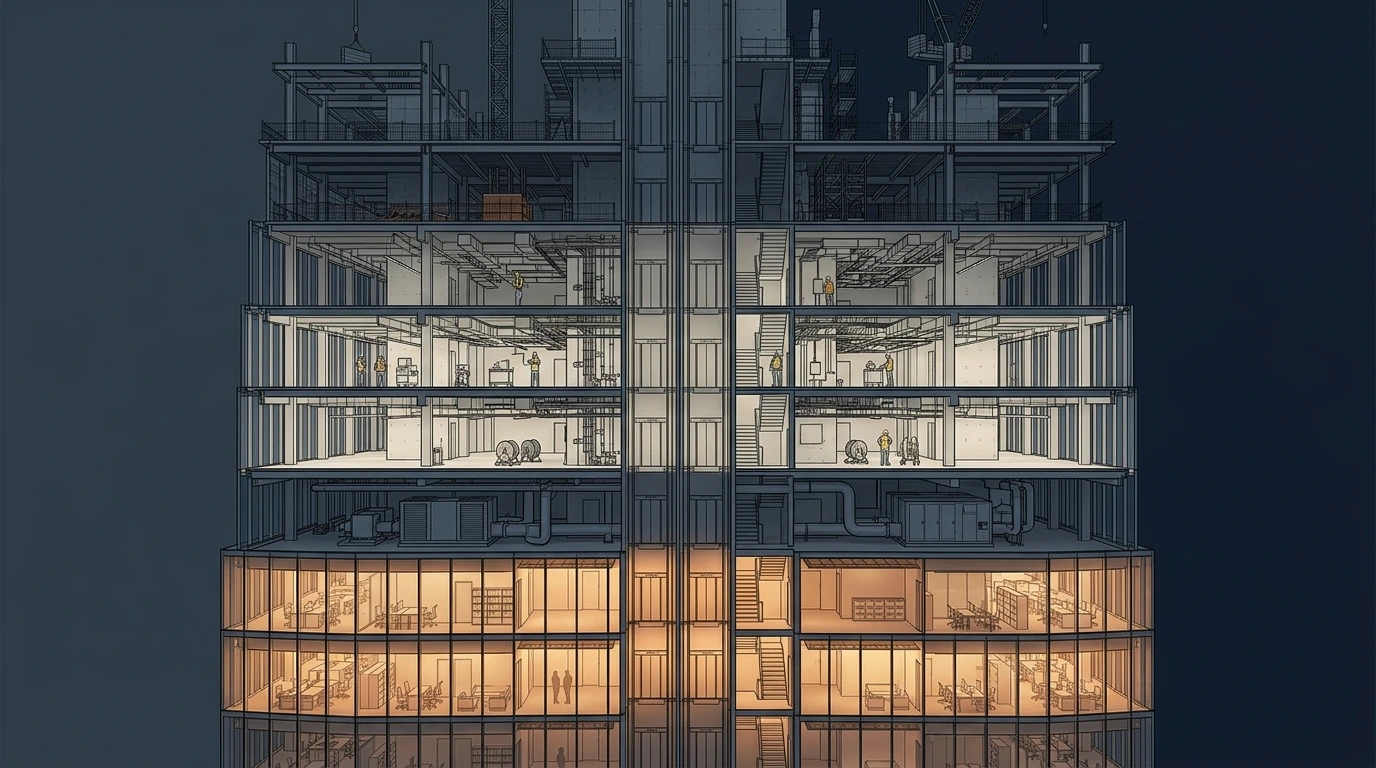
A megatall tower cannot be commissioned the way a normal building is commissioned, because the normal way assumes the building is finished before you start. A 150-storey tower is occupied from the bottom while the top is still being clad; its systems are zoned so that no single test proves anything about the whole; and its design conditions — peak wet bulb, winter stack effect, full occupancy — occur on days that have nothing to do with the programme. Run it sequentially and the commissioning of six zones takes 48 weeks. Overlap it properly and the same work takes 23. That is not a scheduling refinement; it is the difference between commissioning driving the handover date and commissioning fitting inside it.
1 · Why the normal model breaks
- Handover is phased, so testing must be too. Lower floors are occupied while upper ones are under construction. Every zone must be independently testable, independently certifiable and independently isolatable — which is a design requirement, not a site arrangement.
- Nothing can be tested in isolation. A zone's chilled water depends on a heat exchanger on a mechanical floor two zones up; its pressurisation interacts with a stack effect generated by the whole building; its lifts share a shaft with everything. Zone tests prove components; only an integrated test proves the building.
- The design conditions are seasonal and you will miss them. Peak wet bulb, the winter stack case and the Gulf summer reverse stack all occur in narrow windows. A programme that reaches commissioning in March will test none of them.
- The volume is industrial. Three thousand terminal devices at 45 minutes each is 280 man-days of balancing alone — before witnessing, before re-tests, before the integrated systems test.
- Temporary systems become permanent habits. Towers run on temporary cooling and power for years during fit-out; the transition to permanent systems is itself a commissioning event that is almost never planned as one.
2 · Interactive: sequential versus overlapped zone commissioning
The single most effective move is to stop treating commissioning as a phase at the end and start treating it as a pipeline — each zone entering the same sequence a few weeks behind the one above it.
Six zones at eight weeks each is 48 weeks sequentially and 23 weeks at a three-week stagger — but only if you have the teams to run three zones concurrently, which is what the readout checks. Push the stagger down to one week and the theoretical duration falls further while the required team count rises past what any contractor will mobilise. The real constraint is rarely the testing; it is having enough zones actually finished and isolatable to enter the pipeline, which comes straight back to whether the design provided zone isolation, zone metering and zone-level control in the first place.
3 · Interactive: the effort nobody budgets
Three thousand terminals at 45 minutes is 281 man-days, and a realistic 30 % re-test allowance takes it to 366. Add witnessing and it is over 400 man-days — 10 weeks of solid work for four two-person teams, on one building, for balancing alone. That number is almost never in the programme at tender, and it is the single most common cause of commissioning being compressed at the end. Two design decisions cut it dramatically: pressure-independent control valves, which remove most of the proportional balancing entirely, and networked terminal controllers that can be set and verified from a laptop rather than from a ladder. Both are specified years before anyone counts man-days.
4 · The seasonal problem, and what to do about it
Several systems can only be proved at conditions the programme will not reach:
- Cooling tower and chiller capacity — meaningful only near the design wet bulb. Test at the achievable condition and correct to design using the manufacturer's certified performance curves, recording both the raw and corrected results. This is standard practice and it is accepted; what is not accepted is a bare reading at a mild condition presented as a pass.
- Stack-effect-dependent systems — stair and lift pressurisation, door forces, revolving door behaviour. Measure the actual differential pressures at the temperature you have, and extrapolate with the stack equation from stack effect; then re-test in the design season and hold retention against it.
- Heating and low-load performance — often untestable at handover in a Gulf summer. Schedule an explicit seasonal return visit into the contract with a defined scope and a defined payment.
- Full-occupancy behaviour — internal gains, lift traffic, domestic water demand and drainage loading only appear with people in the building. A twelve-month post-occupancy review with trend data is where these are actually resolved.
The contractual answer is to write deferred and seasonal commissioning into the contract from the start, with retention tied to it. If it is not in the contract it will not happen, because by then everyone has demobilised.
5 · The integrated systems test
Zone tests prove that equipment works. The integrated systems test proves that the building works — and in a tall building it is the only test that means anything, because every life-safety function is a chain across several packages:
- Fire alarm → smoke control → lifts → doors → power. A single detector activation must produce the right damper positions, the right fan states, lift recall, door releases, pressurisation start-up and generator changeover. Each package tests its own end; almost nobody tests the chain.
- The cause-and-effect matrix is the deliverable. It must exist as a signed document before testing, listing every input and every required output. Testing without it is a demonstration, not a test.
- Test the failure cases, not just the success cases. Loss of normal power during smoke control; a damper that fails to prove; a fan that does not start; two simultaneous alarms in different zones. These are the scenarios that reveal design assumptions.
- Rehearse it. An IST on a megatall involves dozens of people across many packages and takes days. Run a dry rehearsal of each scenario before the witnessed test; the first attempt always finds interface defects that are nobody's package.
- Re-test after every change. Any subsequent alteration to the matrix invalidates part of the test, and on a phased handover there will be changes.
The numbers here are illustrative — the multipliers are a modelling convention, not measurement — but the shape is not in dispute and it is the whole argument for front-loading. Commissioning one zone early, as a genuine prototype with full witness testing, converts a set of defects that would have been repeated five more times into a single correction applied once. Every defect it catches costs about 4× less to put right than the same defect found after handover, and on the default assumptions the prototype avoids roughly 13 M of correction cost. Put it in the programme as a deliverable with its own milestone, and give it enough float that its findings can actually be fed back into the remaining zones — a prototype whose lessons arrive after the other zones are built is just an expensive first zone.
6 · Practical measures that actually work
- Design for testability. Zone isolation valves and dampers, zone metering, test points either side of every item of plant, permanent flow measurement on every major circuit, and access to every device. If a system cannot be isolated it cannot be phase-handed-over.
- Appoint an independent commissioning authority early — at design stage, not at practical completion — with authority to review the design for commissionability and to sign off the strategy.
- Write the commissioning specification into the tender with the man-day estimate, the seasonal returns, the IST scope and the witness sampling all quantified. What is not priced will not be resourced.
- Instrument for evidence. Permanent differential-pressure sensors on critical doors, state-of-charge on storage, approach on every heat exchanger, and BMS trending switched on from first energisation. Most commissioning arguments are about missing data.
- Insist on a signed cause-and-effect matrix before any integrated testing, and control its revisions.
- Record the conditions with every result. Outdoor dry bulb, wet bulb, wind and occupancy alongside every reading — without them a result cannot be corrected, compared or defended later.
- Plan the temporary-to-permanent transition as a commissioning event with its own method statement, because switching a partly occupied tower from temporary to permanent cooling or power is one of the highest-risk operations in the whole programme.
- Hand over data, not just documents. Point-cloud scans of plant floors, as-set valve schedules, the trend archive and the commissioning records in a usable format — see the handover discussion in mechanical floors.
7 · The design & delivery checklist
- Make every zone independently testable and isolatable — a design requirement, decided at concept.
- Plan commissioning as a staggered pipeline, and check the team count the stagger implies.
- Estimate the man-days honestly and put them in the tender.
- Specify PICVs and networked controllers to cut the balancing effort at source.
- Commission the first zone early as a prototype, with float to feed the findings back.
- Write seasonal and deferred commissioning into the contract, with retention attached.
- Correct capacity tests to design conditions using certified curves, recording raw and corrected values.
- Produce and sign the cause-and-effect matrix before any integrated test; rehearse the IST; test the failure cases.
- Trend from first energisation and record conditions with every reading.
- Plan the temporary-to-permanent switchover as a controlled event.
References & standards
- ASHRAE Guideline 0 The Commissioning Process and Guideline 1.1 HVAC&R Technical Requirements for the Commissioning Process.
- CIBSE Commissioning Code M — Commissioning Management, and Codes A, B, C, R and W for air, water, control and distribution systems.
- BSRIA BG 8 Model Commissioning Plan and BG 49 Commissioning Air Systems / BG 2 Commissioning Water Systems.
- ANSI/ASHRAE/IES Standard 90.1 and LEED / Estidama / Mostadam commissioning and enhanced-commissioning requirements.
- NFPA 3 Standard for Commissioning of Fire Protection and Life Safety Systems and NFPA 4 Standard for Integrated Fire Protection and Life Safety System Testing — the basis of the integrated systems test.
- ASHRAE Design Guide for Tall, Supertall, and Megatall Building Systems, 2nd ed. — phased handover, zone commissioning and vertical logistics.
- CTI ATC-105 and ARI/AHRI certification programmes — correction of capacity test results to design conditions.
- Soft Landings framework (BSRIA BG 54) — aftercare, seasonal commissioning and post-occupancy review.