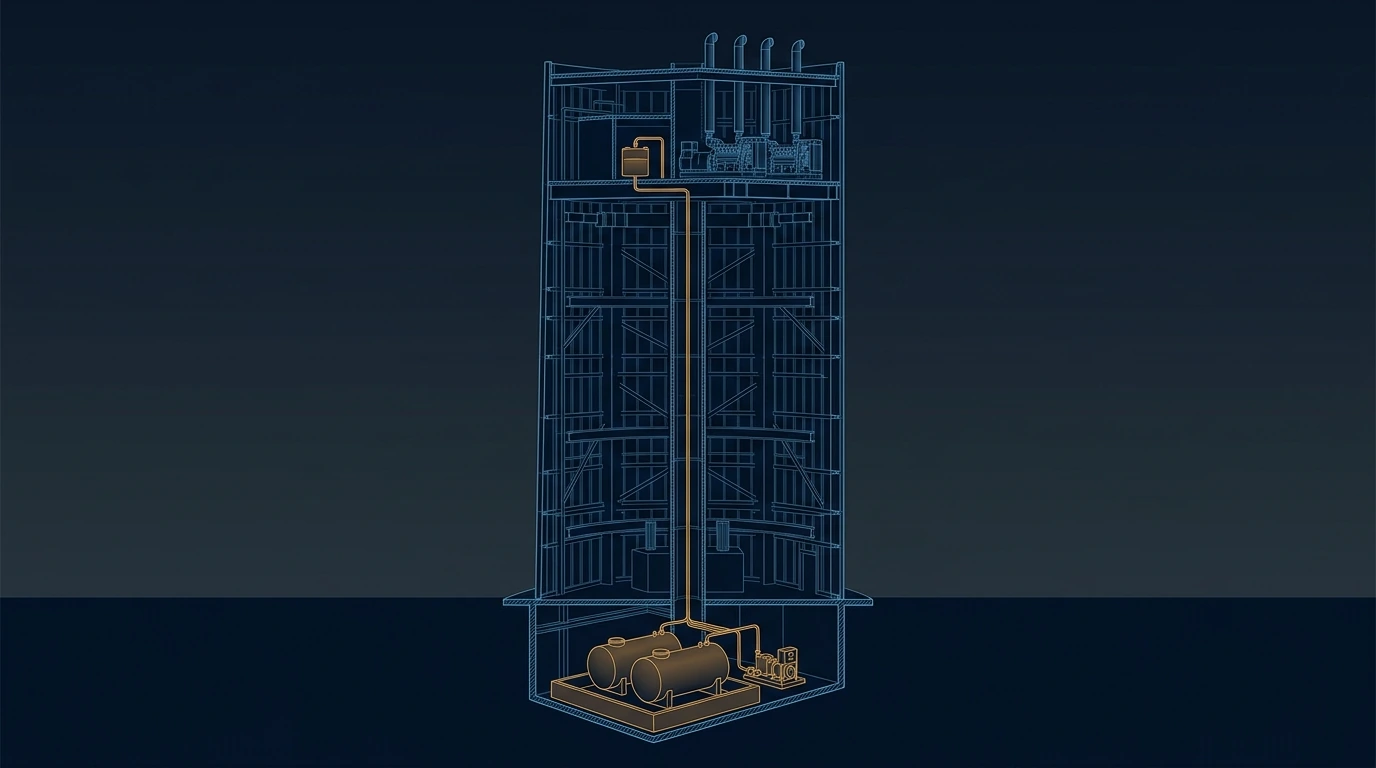
Standby generators and diesel fire pumps are the systems that only matter on the day everything else has failed — and both of them run on a fuel that has to be stored in quantity, moved vertically through occupied floors, and kept ready for years without degrading. A 5 MW generator set with 24 hours of autonomy needs 26 m³ of diesel — 22 tonnes — and if the generators sit on a high mechanical floor rather than in the basement, the transfer system has to push that fuel up a riser against 25 bar of static head at 300 m. Every one of those facts is a fire-safety constraint before it is a mechanical one, which is why fuel systems in tall buildings are governed less by pump selection than by where the code will let you put the tank.
1 · Why fuel is different from every other service
- It is a fuel load inside the building. Twenty-odd tonnes of diesel is a substantial fire load with its own compartmentation, ventilation, containment and detection requirements, and its location is normally fixed by code rather than by convenience.
- The riser is a hazard, not a utility. A fuel line running vertically through a tower must be protected, contained, monitored for leaks and capable of being isolated remotely — nothing like a water riser.
- Quantities in occupied areas are capped. Codes limit how much fuel may sit at the equipment, which is why the system is almost always bulk storage plus small day tanks rather than one large tank at the plant.
- It must work after years of standing still. Diesel degrades, absorbs water, and grows microbial contamination. A generator that has never failed a monthly test can still fail on fuel that has been sitting since handover.
- Two independent duties. Standby generators and diesel fire pumps have different code bases, different autonomy requirements and, usually, must not share a fuel supply in a way that lets one exhaust the other.
2 · Interactive: how much fuel, and how much it weighs
A 5 MW set at 80 % load burns 1,080 L/h, so 24 hours is 25.9 m³ and nearly 22 tonnes of fuel, in a bunded room, with a 28.5 m³ containment. Two design points that get missed. First, the load factor matters more than the generator rating — sizing storage at 100 % load when the real standby demand is 60 % buys nearly double the tank for nothing. Second, look at the tanker readout: autonomy is only meaningful if fuel can actually be delivered, so the real design question is not "how many hours" but "how long until a tanker can reach the site and discharge", which in a city centre after a regional event may be considerably longer than the tank.
3 · Interactive: pushing fuel up the tower
Generators are increasingly placed on high mechanical floors — for exhaust dispersion, for shorter electrical runs, and because basement space is scarce. That turns fuel transfer into a vertical pumping problem with a fire-safety overlay.
Lifting diesel to a 300 m mechanical floor is 24.7 bar of static pressure — a PN40 riser and PN40 valves for a flammable liquid running through occupied floors. Note the day-tank runtime: at 2,000 L and 1,080 L/h the set has under two hours before it needs the transfer pumps, so those pumps are as safety-critical as the generator itself and must be on the essential board, duplicated, and proven during the monthly test rather than assumed. Above about 200 m the honest answer is often intermediate tanks at zone breaks — the same cascade logic as fire water in firefighting in megatall buildings — which keeps every section inside a sane pressure class at the cost of more tanks to permit, bund and monitor.
4 · Day tanks, transfer and the control that matters
- Size the day tank on code first, runtime second. Many jurisdictions cap the quantity permitted at the equipment inside a building; that cap, not the runtime you would like, sets the tank.
- Duplicate the transfer pumps and their power. Duty and standby, both on the essential supply, with automatic changeover on failure to achieve level — the failure that matters is not the pump, it is the pump that did not start.
- Prevent overfill mechanically, not just electrically. A high-level float switch plus an independent overfill prevention device plus an overflow returning by gravity to the bulk tank. Relying on a single level probe is how a mechanical floor gets flooded with diesel.
- Design the return leg. Engines return more fuel than they burn; the return must go somewhere thermally sensible and must not pressurise the day tank or push hot fuel back into the bulk store.
- Fit remote isolation. A remotely operated shut-off at the bulk tank and at each floor served, operable from the fire command centre, is required by most codes and is worth having regardless.
- Contain the riser. Double-wall pipe or a contained duct with leak detection over the full height, draining to a monitored point — a single-skin fuel line in a shaft is not acceptable in a tall building.
5 · Interactive: the diesel fire pump's own fuel
Diesel-driven fire pumps have their own, entirely separate rule. NFPA 20 sizes the base tank from the engine's rated power — roughly 5.07 litres per rated horsepower plus 5 % — and that tank must be dedicated, not shared with the generators[2].
A 300 hp fire pump driver takes a 1,192 L base tank under the NFPA 20 rule, which at 0.21 L/hp·h is nearly 19 hours of running — far more than the eight hours the fire strategy asks for. That is deliberate: the rule is a prescriptive minimum designed to remove judgement, and in a zoned megatall with a pump set per zone it means four separate dedicated tanks totalling 4,800 L, each with its own bund, fill point, level monitoring and weekly test regime. Do not attempt to consolidate them into one tank serving several pump rooms — the whole point of the rule is that each set is independent of every other system in the building.
6 · Fuel that has been standing for five years
The commonest cause of a standby system failing is not the machine, it is the fuel. Diesel in a rarely used tank degrades in three ways at once, and all three are designed against rather than maintained against:
- Water accumulates from condensation in the tank headspace and from deliveries. Water at the tank bottom is where microbial growth lives. Provide a proper sump, a low-point drain that somebody can actually reach, and a water-detection alarm.
- Microbial contamination — "diesel bug" — grows at the fuel-water interface and produces sludge that blocks filters, usually on the second or third hour of the outage rather than at start-up.
- Oxidation and gum formation, accelerated by heat and by copper. Biodiesel blends are markedly worse: FAME content absorbs water and degrades faster, and in some regions the pump-grade fuel now contains it whether you specify it or not.
- The design responses are a fuel polishing system that circulates and filters the bulk store on a timer, tank geometry that lets water collect where it can be drained, breather driers on the tank vents, and periodic sampling and testing written into the O&M with action limits.
- Test under load. A monthly no-load run proves the starter battery. It does not prove the fuel, the transfer pumps, the day-tank controls or the cooling — those need a periodic load-bank or building-load test, and that test is where fuel problems reveal themselves harmlessly.
7 · Installation & execution tricks
- Fix the tank locations with the fire engineer before the basement is laid out. Fuel room location, fire rating, ventilation, access and the tanker fill route are code-driven and almost impossible to move later.
- Bund everything to 110 % of the largest tank, with the bund drained to a monitored, valved point that is normally closed — an open bund drain is not a bund.
- Put the fill point where a tanker can actually stand, with the hose run, the spill kit, the overfill alarm audible at the tanker and a lockable cap. This is coordinated with the traffic engineer, not with the plant room.
- Double-contain and leak-detect the riser over its full height, with the interstitial space monitored and alarmed.
- Separate fuel from everything hot and everything electrical in shafts and plant rooms, and fire-stop every penetration to the rated standard.
- Commission the whole chain under load — bulk tank to transfer pump to day tank to engine, with level controls, overfill protection, remote isolation and the alarm path all proven, at load, not at idle.
- Label and document the isolation points and put the fuel schematic on the wall of the fire command centre.
- Write the fuel management regime into the O&M: sampling frequency, polishing schedule, water-drain interval, action limits and who is responsible.
8 · The design & installation checklist
- Establish the code constraints first — permitted quantities, tank locations, day-tank caps, separation.
- Size storage on realistic load factor and on delivery logistics, not on generator rating alone.
- Decide generator location knowing the fuel consequence — a high plant floor means a high-pressure fuel riser or intermediate tanks.
- Duplicate transfer pumps on essential power with automatic changeover.
- Provide independent overfill protection and a gravity overflow route.
- Keep fire pump fuel entirely separate and size it to NFPA 20 per set.
- Design for fuel quality — polishing, water drainage, breather driers, sampling.
- Double-contain and monitor the riser, with remote isolation.
- Commission the whole chain at load and test periodically at load thereafter.
References & standards
- NFPA 110 — Standard for Emergency and Standby Power Systems: fuel supply, day tanks, run time classes and testing regimes.
- NFPA 20 — Standard for the Installation of Stationary Pumps for Fire Protection: diesel driver fuel tank sizing, dedicated supply and weekly testing.
- NFPA 30 — Flammable and Combustible Liquids Code, and NFPA 37 for stationary combustion engines: permitted quantities, tank location, containment and separation.
- International Fire Code / Saudi Building Code SBC 801 — storage of combustible liquids in buildings, fuel rooms and remote shut-off requirements.
- BS 5410 and the UK Oil Firing Technical Association (OFTEC) guidance — oil supply installations, bunding and fill point arrangements.
- EN 590 and ASTM D975 — diesel fuel specifications; and ASTM D6469 / IP guidance on microbial contamination and fuel storage stability.
- ASHRAE Design Guide for Tall, Supertall, and Megatall Building Systems, 2nd ed. — generator and fuel plant location in tall buildings.
- Engine manufacturers’ installation manuals — fuel supply and return temperature limits, lift limits and day tank arrangements.