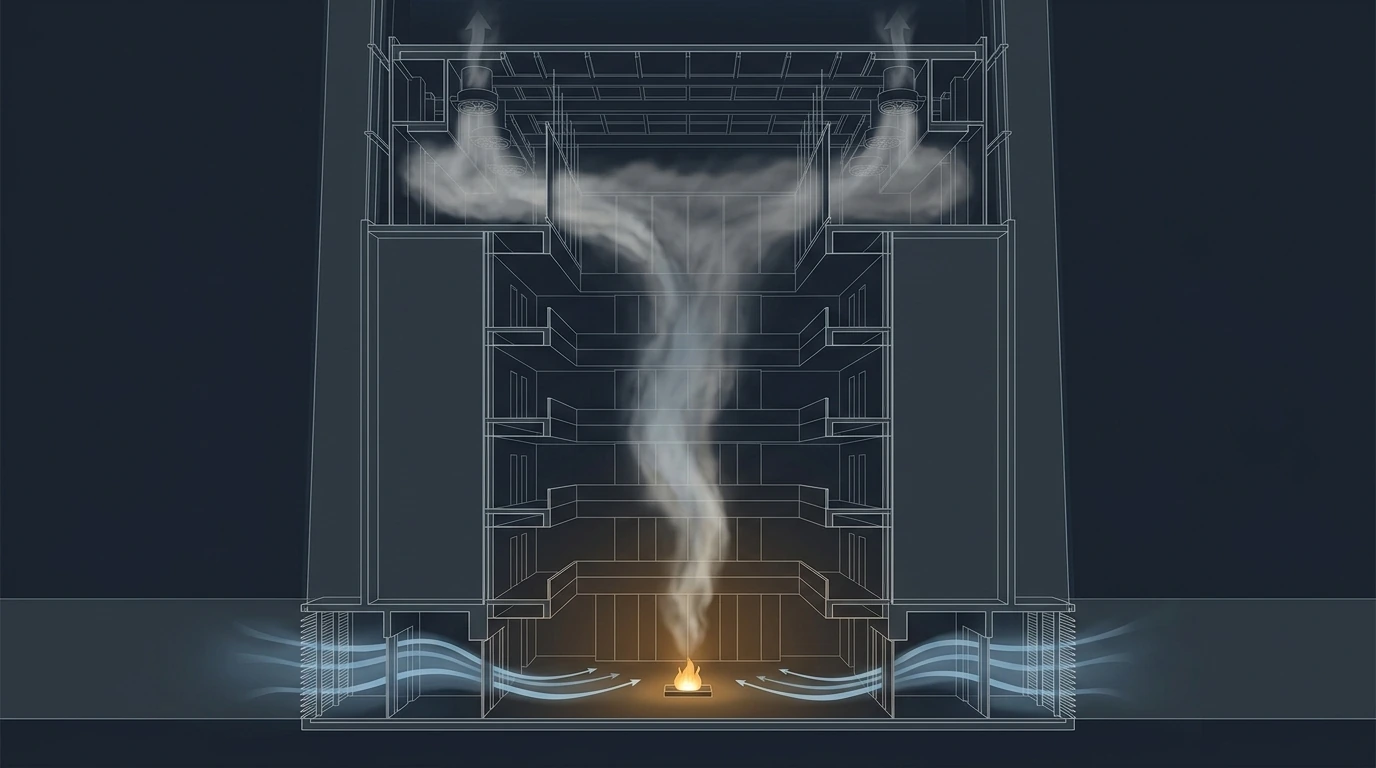
Every megatall development has an atrium — a hotel lobby, a retail galleria, a sky lounge — and every atrium is a compartment the fire code was not written for. Its whole purpose is that it is not divided, so the ordinary defence of compartmentation does not apply and the building must instead prove, by calculation, that smoke will stay above people's heads for long enough to get them out. The arithmetic is unforgiving: a 5 MW fire in a 20 m atrium drops the clear layer from the ceiling to 5.7 m in five minutes. Holding it there needs 33 m³/s of exhaust — and, far more awkwardly, 32 m² of make-up air opening, because the replacement air must arrive slowly enough not to blow the smoke plume sideways.
1 · Why an atrium is a special case
- There is no compartment. The atrium deliberately connects many floors, so smoke reaches all of them. The only defences are keeping the smoke high, removing it, or keeping it out of the occupied edges.
- The design is performance-based. There is no table to look up. You choose a design fire, calculate the plume, calculate the filling, and demonstrate tenable conditions for the required evacuation time — and every one of those steps is an assumption an approving authority can challenge.
- The plume is the system. Everything follows from how much air the fire entrains on the way up, and that grows steeply with height — which means a taller atrium is harder, not easier, because the smoke arriving at the ceiling is cooler, more voluminous and less buoyant.
- Make-up air is the part that fails. Exhaust is easy to specify and hard to feed. Provide it through openings that are too small and the inrush tears the plume apart, mixes the layers and destroys the very stratification the system exists to create.
- It interacts with the tower's own stack effect. A tall atrium is itself a chimney with the pressure regime described in stack effect, and on a cold or a Gulf-summer day that regime can be stronger than the smoke system.
2 · Interactive: how fast the smoke layer descends
With no exhaust running, the smoke layer descends as the plume fills the volume from the top down. NFPA 92 gives a correlation for a steady fire in a uniform space[1]:
with \(z\) the clear height, \(H\) the atrium height, \(A\) the plan area, \(\dot Q\) the fire heat release rate and \(t\) time. Note that \(A\) and \(H\) both help and \(\dot Q\) hurts only as the cube root — you cannot exhaust your way out of a fire that is too big, but a generous volume genuinely buys time.
A 5 MW fire in a 20 m, 2,000 m² atrium leaves only 9 minutes before the smoke reaches head height with no exhaust running. That is the number the whole strategy is measured against: if the required safe egress time exceeds it, you need exhaust, and if it does not, natural filling may be enough. Drag the fire size and watch how weakly it matters — doubling the fire barely moves the curve, because the plume entrains as the cube root of heat release. Then drag the height: volume is what buys time, and it is an architectural gift rather than an engineering one.
3 · The plume — the calculation everything rests on
The mass of smoke arriving at the layer is almost entirely entrained air, not combustion products. For an axisymmetric plume above the flame tip[1][2]:
with \(\dot Q_c\) the convective heat release (typically 70 % of total) and \(z\) the height from the fire to the smoke layer. The \(z^{5/3}\) is the critical term: entrainment grows faster than linearly with height. Hold the layer at 12 m instead of 6 m in the same atrium and the exhaust needed more than doubles — which is the counter-intuitive result that a higher clear layer is much more expensive than a lower one, and why designers fight for every metre of permitted smoke reservoir depth.
A 5 MW fire with the layer held at 6 m needs 33 m³/s of exhaust, at a layer temperature of about 147 °C. Raise the clear layer to 12 m and it becomes 71 m³/s — more than double, for a layer that is only twice as high. Note also what happens to the temperature: the deeper the layer sits, the hotter and more buoyant the smoke, which makes the system easier to run. A cool, thin, high smoke layer is the hardest thing to extract and the most likely to destratify — which is why systems designed for a very high clear layer in a very tall atrium are the ones that fail in CFD.
4 · Interactive: the make-up air problem
Whatever you exhaust must come back in, and NFPA 92 limits the velocity of that replacement air to about 1.02 m/s where it could reach the plume — because faster air deflects the plume, tears it, and mixes the smoke layer down into the clear layer.
This is where atrium smoke systems are lost. Holding a 6 m layer needs 33 m³/s, and at the 1.02 m/s limit that demands 32 m² of free make-up area — the equivalent of a dozen wide doorways, all of which must be open during the fire and none of which the architect wants. Provide the 12 m² that is typically available and the inrush runs at 2.75 m/s, well past the limit, and the CFD will show the plume being pushed off vertical and the layer mixing down. The resolutions are all architectural and all early: more openings, a dedicated mechanical make-up system with low-velocity diffusers, or a lower clear-layer requirement agreed with the fire engineer. Discover it late and the only remaining option is a bigger fan, which makes it worse.
5 · The strategy choices
- Natural (buoyancy-driven) ventilation. Vents at the top of the atrium, sized on the layer depth and temperature. Simple, needs no power, and fails when the smoke is cool — which is exactly what a sprinklered fire in a tall atrium produces. Check it against the coolest credible layer, not the hottest.
- Mechanical exhaust. Fans at high level, rated for the layer temperature, on essential power. Predictable and controllable but requires the make-up problem to be solved and brings a plugholing constraint at each extract point.
- Depressurisation of adjacent spaces rather than atrium exhaust — holding the balconies and adjoining floors at a lower pressure so smoke cannot spill into them. Sometimes far more economical in a tall thin atrium.
- Smoke reservoirs and channelling screens. Downstands that contain the layer over the fire and stop it spreading laterally, which reduces the exhaust rate dramatically. The cheapest intervention available and the first to be deleted for aesthetic reasons.
- Do nothing, and prove it. Where the atrium volume is large and the occupancy escapes quickly, the filling calculation may show the layer never reaches head height within the egress time. This is a legitimate and often overlooked answer — but it must be demonstrated, and it must be robust to a larger fire.
6 · Design, installation & commissioning
- Agree the design fire in writing, early. Its size, growth rate, location and whether sprinkler control is assumed. Everything downstream is a consequence of that one agreement, and re-opening it late redesigns the system.
- Check the coolest case as well as the hottest. Sprinkler-cooled smoke is the hard case for buoyancy-driven systems and for stratification; a hot fire is the hard case for fan and structure temperature ratings.
- Model the stack effect together with the smoke system. In a tall atrium the two are comparable in magnitude and can oppose each other; a smoke system verified with no stack pressure is verified against a condition that never occurs.
- Watch for pre-stratification. A glazed atrium develops a hot layer under the roof on a sunny day; smoke rising into air warmer than itself stops and spreads at that level rather than reaching the roof vents. Model it, and consider extract points below the roof.
- Rate the fans, and everything attached to them. Temperature-time class for fans, motors, bearings, flexible connections, supports and cabling, with power from an essential supply and a tested changeover.
- Make the make-up path automatic and proven. Motorised doors or louvres that open on alarm, with position proving to the fire system — a manual door that somebody must open is not make-up air.
- Commission with hot smoke, not cold. Cold smoke tests prove damper and fan operation but tell you nothing about stratification; a hot smoke test to a recognised protocol is what demonstrates the layer actually behaves as modelled.
- Re-verify after any fit-out change. A new mezzanine, a shopfront or a change of use alters the volume, the fuel load and the make-up path, and invalidates the model.
7 · The design & installation checklist
- Agree the design fire and the required safe egress time before any calculation.
- Run the filling calculation first — the answer may be that no exhaust is needed.
- Calculate the plume at the required clear height, and challenge that height because it is expensive.
- Solve make-up air at concept stage — free area, velocity and how it opens.
- Split the exhaust and check every extract point for plugholing.
- Use reservoirs and channelling screens to cut the exhaust rate before adding fans.
- Check the coolest and the hottest case, and model stack effect and solar pre-stratification.
- Rate fans and all attached components for the temperature-time class, on essential power.
- Prove make-up openings automatically, and commission with a hot smoke test.
References & standards
- NFPA 92 — Standard for Smoke Control Systems: filling correlations, plume equations, make-up air velocity limits and plugholing criteria.
- Klote, J.H. & Milke, J.A. Handbook of Smoke Control Engineering (ASHRAE / SFPE / ICC) — atrium smoke management, plume models and design fires.
- SFPE Handbook of Fire Protection Engineering — fire plumes, entrainment, heat release rates and design fire selection.
- BS 7346-4 and BS 9999 — functional recommendations for smoke and heat exhaust ventilation systems, smoke reservoirs and channelling screens.
- EN 12101 series — smoke and heat control systems: natural and powered exhaust ventilators, and their temperature-time classification.
- Hansell, G.O. & Morgan, H.P. (BRE) — design approaches for smoke control in atrium buildings.
- International Building Code (IBC) and Saudi Building Code SBC 801 — atrium provisions and smoke control requirements.
- Hot smoke test protocols (for example AS 4391) — commissioning verification of smoke management performance.