Introduction
Variable Frequency Drives (VFDs) are often presented as universal solutions for flow control and energy efficiency in pumping systems. This article challenges that misconception. A VFD is merely a tool that must operate within the laws of Affinity Laws and System Curves — applying it without understanding these fundamentals can create more problems than it solves.
1. The Trap of Static Head Dominance
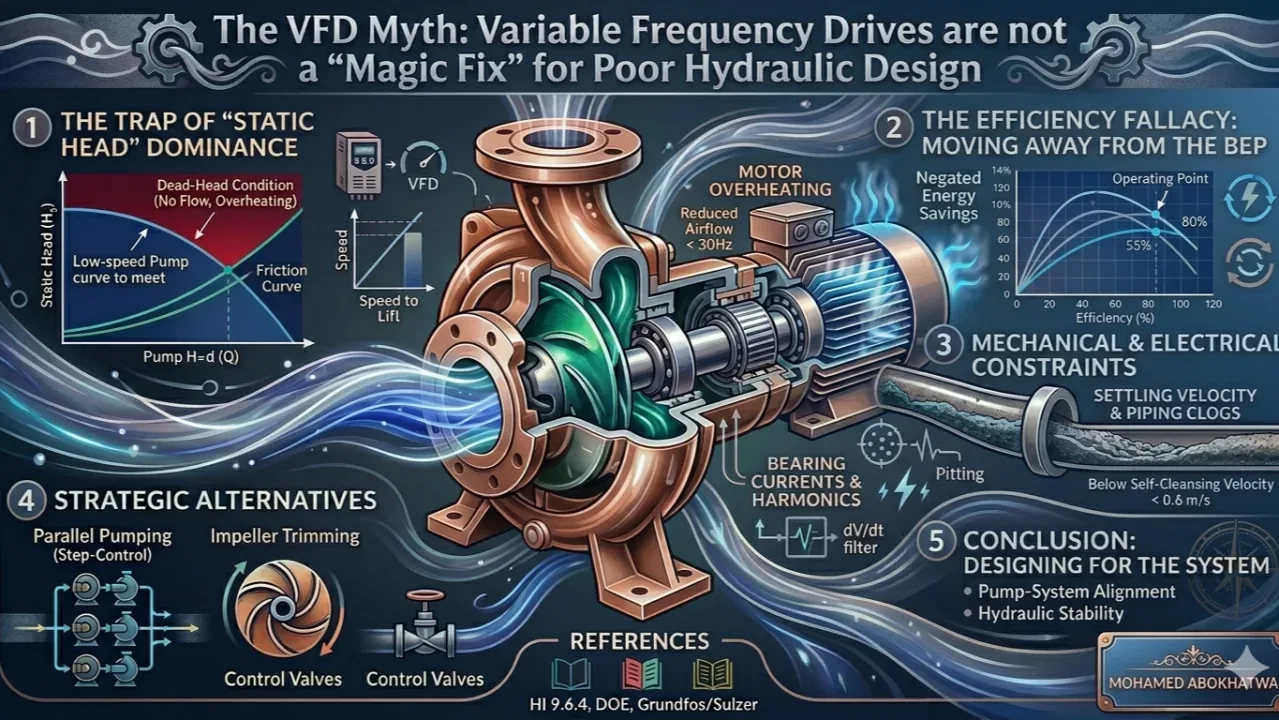
In applications with high static heads (e.g., wastewater lift stations, high-rise building services), VFDs have significant limitations. While pump performance follows Affinity Laws, the system curve does NOT scale proportionally.
Design Rule: VFDs work effectively in friction-head-dominated systems but have a narrow effective operating range in static-head-dominated applications.
2. The Efficiency Fallacy: Drifting from BEP
Every pump has an optimal Best Efficiency Point (BEP). When VFDs reduce speed to meet lower flow demands, the operating point shifts away from peak efficiency. As speed decreases, the pump's efficiency curve "shrinks" — new operating points outside the Preferred Operating Region (POR) cause:
- Internal hydraulic recirculation and vibration
- Increased mechanical loads on bearings and seals
- Net energy savings may be negated by reduced hydraulic efficiency
Example: A pump at 100 m³/hr, 80% efficiency at 50 Hz may drop to 55% hydraulic efficiency when slowed to 60 m³/hr via VFD — negating the electrical savings.
3. Mechanical and Electrical Constraints
Motor Cooling Issues
Standard motor cooling relies on shaft-mounted fans. At frequencies below 30 Hz, insufficient air circulation causes motor overheating despite low load conditions. Force-cooled motors (separate fan) are required for sustained low-speed operation.
Settling Velocity in Wastewater
Excessive speed reduction via VFD can cause discharge pipe velocity to fall below the self-cleansing velocity (0.6–0.9 m/s), resulting in sedimentation and pipe clogging.
Harmonics and Bearing Damage
VFDs induce high-frequency switching noise causing bearing currents and "pitting" — leading to premature failure without proper dV/dt filters or grounded shaft brushes.
4. When to Use (and Not Use) a VFD
| Situation | Recommendation | Reason |
|---|---|---|
| Friction-dominated system with variable demand | VFD appropriate | System curve scales similarly to pump curve |
| High static head (>70% of total head) | Consider alternatives | Narrow effective speed range, Dead-Head risk |
| Conservative pump sizing (H overestimated) | Impeller trimming | Permanent, high-efficiency, no power electronics |
| Multiple pumps needed | Parallel pump staging | Each unit near BEP |
References
- Hydraulic Institute (HI) 9.6.4: Variable Speed Pumping
- U.S. Department of Energy (DOE): Variable Speed Pumping — A Guide to Successful Applications
- Grundfos/Sulzer Technical Handbooks: The Pitfalls of Low-Speed Operation