Introduction
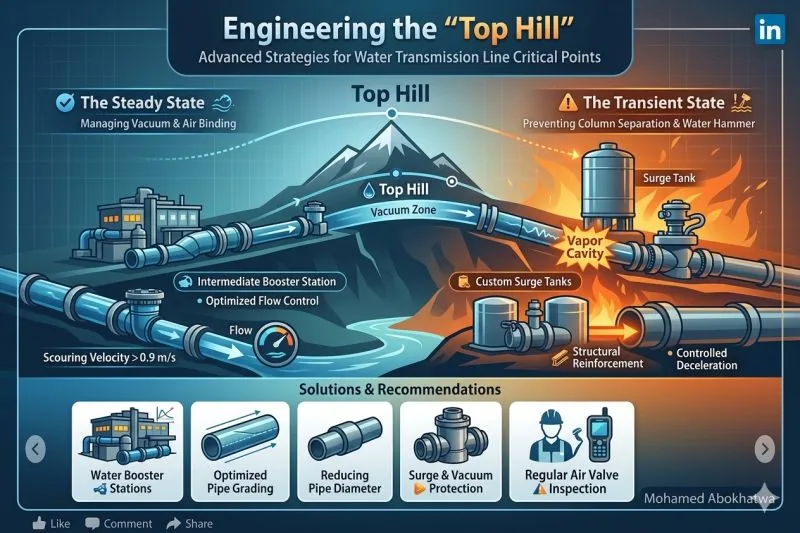
Every pipeline route that crosses elevated terrain presents one of the most challenging hydraulic problems in water engineering: managing the "Top Hill" challenge — where the pipeline summit approaches or exceeds the Hydraulic Grade Line (HGL). Failure to address this correctly leads to air binding, pressure vacuum, or catastrophic surge events.
1. Steady State Issues at Pipeline Summits
- Air Binding: Low pressure causes air to come out of solution, forming pockets that throttle flow and distort the HGL
- Vacuum Conditions: When HGL drops to pipe elevation, external air infiltration risk increases — especially dangerous for older pipelines
- Solutions: HGL optimization through pumping pressure adjustment, pipe grading to ensure continuous upward slope, and active air management through properly sized combination air valves
Maintain a minimum 5–10 metre HGL clearance above the pipe profile at all high points under all operating conditions, including minimum flow scenarios.
2. Transient State Issues
- Column Separation: During sudden pump trips, pressure at the summit can drop to vapor pressure (~−1.0 bar gauge). The water column physically separates, creating a vapor cavity
- Rejoining Impact: When pressure recovers, the two water columns rejoin with catastrophic impact forces — often many times the steady-state operating pressure
- Mitigation: Surge tanks at or near the high point, vacuum breakers, and validated transient analysis using HAMMER or equivalent software
Column separation is not just a hydraulic issue — it is a mechanical integrity threat. The implosion force when vapor cavities collapse can fracture even schedule-heavy steel pipe.
3. Design Recommendations
| Measure | Application |
|---|---|
| Minimum 5–10 m HGL clearance above pipe profile | All operating conditions |
| Ascending slope ≥ 0.3%, Descending slope ≥ 0.5% | Profile grading guideline |
| Full vacuum-rated pipe class at summit sections | Pipe specification |
| Transient model validation with pump trip scenarios | Before finalizing protection strategy |
| Regular air valve maintenance and inspection program | Operations and Maintenance |