The Core Question
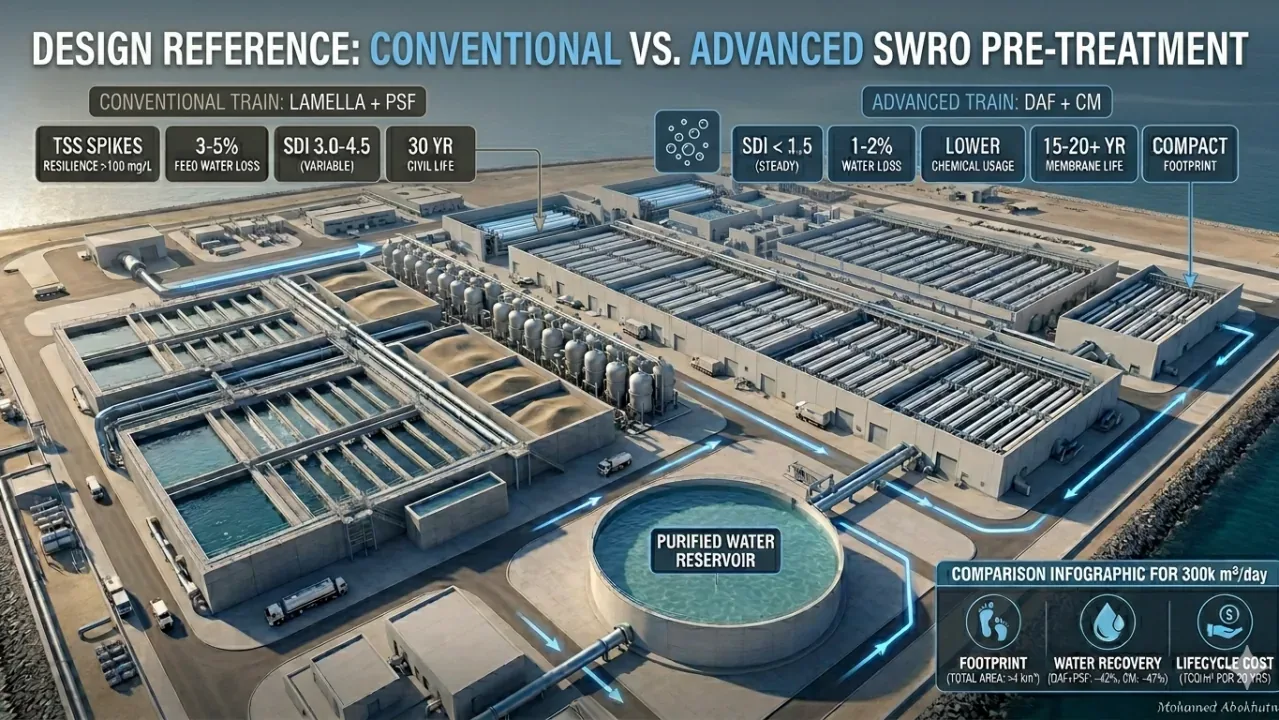
Every SWRO pre-treatment system must deliver SDI₁₅ < 3 to protect RO membranes. Two fundamentally different technology paths achieve this: conventional gravity-based clarification paired with pressurized sand filtration, or advanced membrane systems using ultrafiltration (UF) or ceramic membranes. The choice has major implications for CAPEX, OPEX, footprint, and long-term operational risk.
Conventional: Lamella + PSF
Lamella (inclined plate) clarifiers combined with pressurized sand filters (PSF) represent the established approach. Capital costs are lower, and the technology is well-understood with decades of operational data. However, SDI performance fluctuates with feed water quality changes — during algal blooms or storm events, SDI can spike to >5, risking membrane fouling. Systems require larger footprints and more operator attention during variable water quality periods.
Advanced: UF & Ceramic Membranes
Polymeric UF membranes offer consistent SDI < 2 regardless of feed quality variations — a significant reliability advantage. Ceramic membranes add physical robustness for aggressive cleaning with high-concentration acids or oxidants. Footprint is typically 40–60% smaller than conventional systems for equivalent capacity. The trade-off is higher CAPEX and increased chemical consumption for backwashing and CIP cycles.
Water Recovery Considerations
Conventional pre-treatment typically achieves 95–97% recovery with minimal backwash waste. UF systems operate at 90–95% recovery with regular backwash and periodic CIP, generating a concentrated waste stream requiring careful disposal management. For inland brackish water applications, this waste stream becomes a significant design constraint.
Decision Framework
- Choose Lamella + PSF when: feed water quality is consistently good (SDI < 4), plot space is ample, and CAPEX minimization is the priority
- Choose UF/Ceramic when: feed water quality is variable or poor, footprint is constrained, or membrane warranty requirements specify SDI < 2