The Paradox Defined
In RO plant design, the instinct is to add safety margins everywhere — more membrane elements, higher pump head, conservative fouling factors. The assumption is that more capacity always provides protection. In practice, over-design creates operating conditions that accelerate the very failures it was intended to prevent.
Flux Distribution Problems
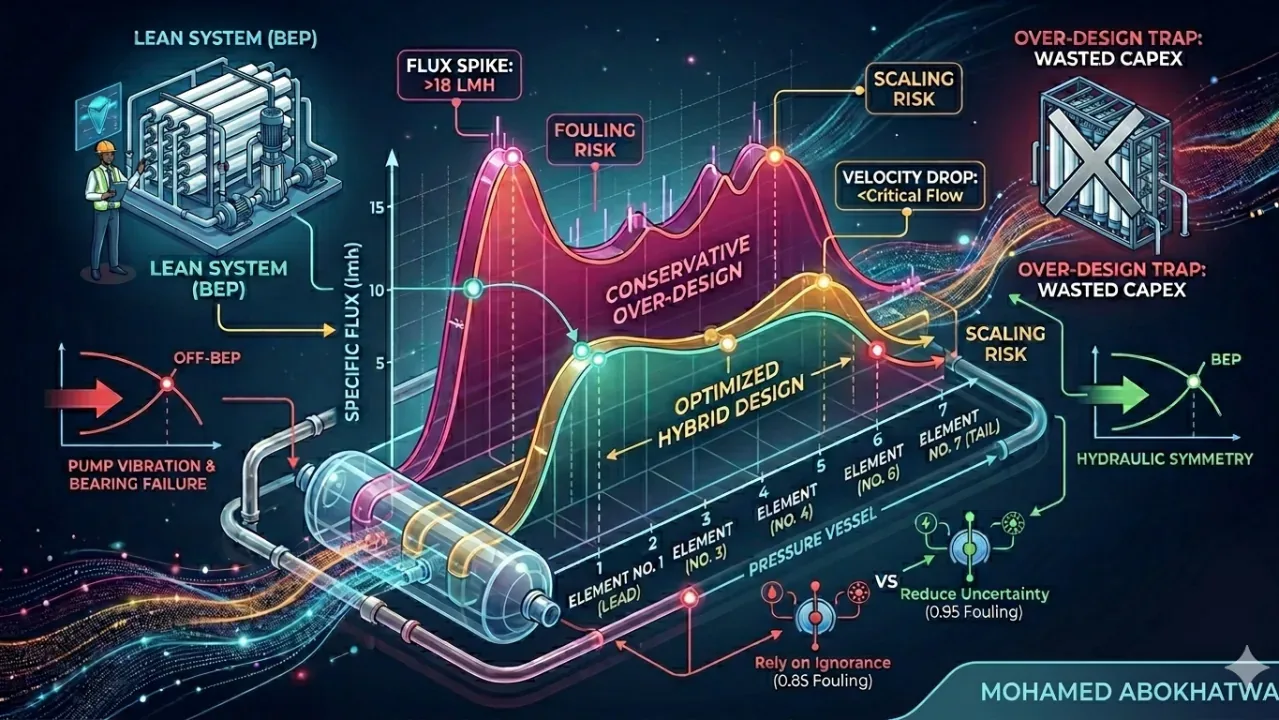
When a pressure vessel contains more membrane elements than needed for the design flow, the flux per element is lower than optimal. This creates an imbalance: lead elements (at the feed end) receive higher-salinity feed and operate at lower flux, while tail elements see lower salinity but still produce at lower-than-optimal recovery. Hybrid membrane configurations — mixing low-permeability lead elements with higher-flux tail elements — can correct this imbalance without adding unnecessary capacity.
Pump Oversizing and BEP Deviation
High-pressure pumps sized with excessive head margins operate far from their Best Efficiency Point (BEP) during normal operation. Operation away from BEP increases radial and axial loads on bearings, accelerates mechanical seal wear, and reduces hydraulic efficiency by 5–15%. For a 10,000 m³/day plant, this represents a continuous energy penalty of 30–80 kW.
The Fouling Factor Fallacy
Applying a conservative fouling factor (e.g., 0.85) to the design flux as a "safety margin" masks poor pretreatment performance. Instead of fixing the pretreatment process, the design accommodates degraded membrane performance from the start — essentially designing for failure. The correct approach is to invest in robust automated pretreatment control that maintains consistent SDI, then design membranes for the actual clean operating flux.
The Right Approach
Lean RO design means sizing for the "most probable" operating scenario, then providing calculated flexibility for extremes through recoverable control strategies — rather than permanent over-capacity. Key tools include: variable frequency drives on feed pumps, interstage booster pump capability, and modular membrane train design allowing future capacity addition with minimal modifications.