The Energy Problem in SWRO
Seawater reverse osmosis requires feed pressure of 55–80 bar to overcome osmotic pressure and drive water through semi-permeable membranes. Without energy recovery, all of this pressure energy would be lost in the reject (brine) stream — which typically represents 40–60% of the feed flow. For a 100,000 m³/day plant, this would mean wasting approximately 15–25 MW continuously.
How PX Devices Work
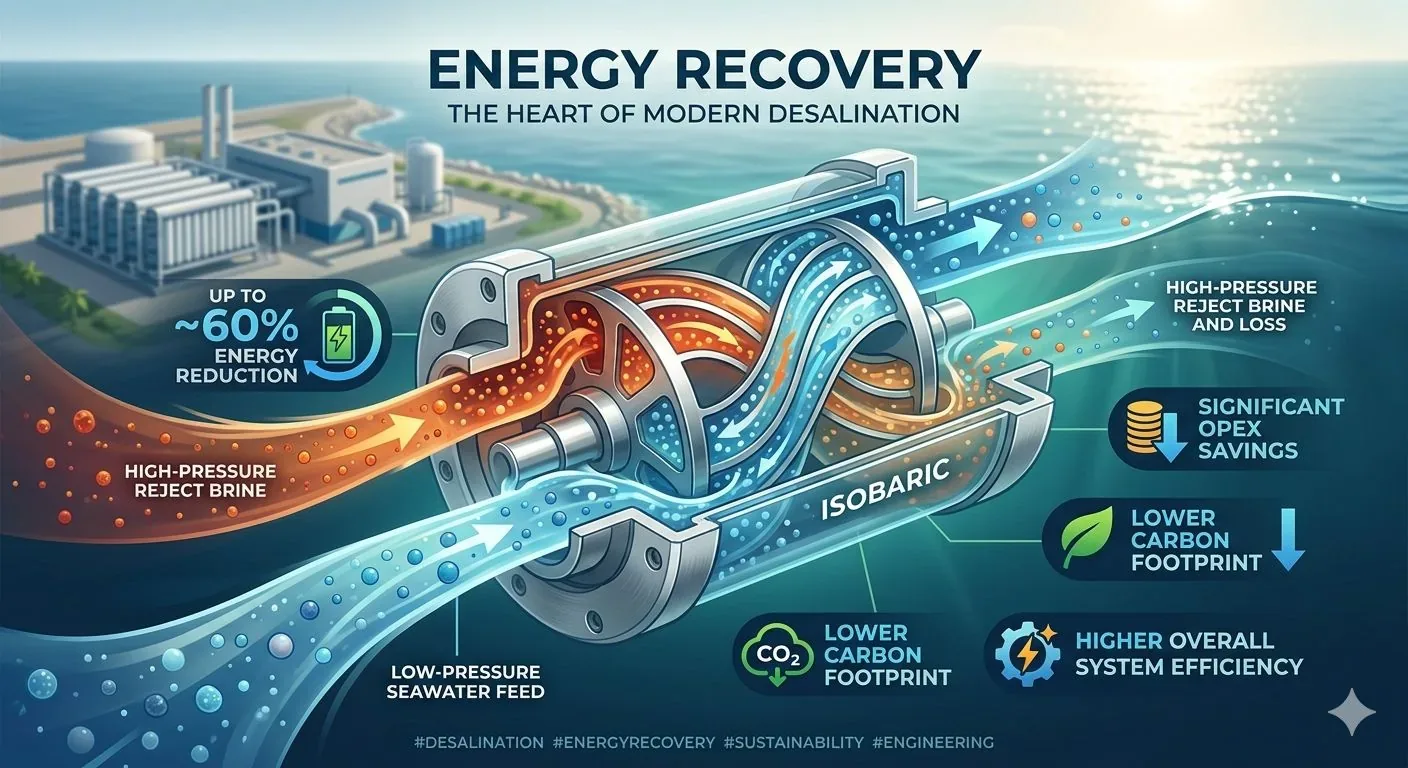
Pressure Exchanger (PX) devices use an isobaric (equal pressure) mechanism: high-pressure brine from the RO reject outlet directly pressurizes incoming low-pressure seawater feed within a rotating ceramic sleeve. There are no intermediate fluid connections — the energy transfer occurs through direct hydraulic contact. Efficiency exceeds 97%, with essentially no moving parts other than the rotor assembly, resulting in exceptionally high reliability and low maintenance requirements.
~60% Energy Reduction
Without energy recovery, a typical SWRO system consumes 8–10 kWh/m³. With PX technology, this drops to 2.5–3.5 kWh/m³ — a reduction of approximately 60–65%. This dramatic improvement fundamentally changed the economics of desalination, making large-scale SWRO competitive with conventional water supply sources in water-scarce regions.
Integration Considerations
PX devices require a small booster pump (typically 1.5–2.0% of system energy) to compensate for pressure losses within the exchanger. Over-flush ratio — the amount of brine used to displace the seawater slug between cycles — must be precisely controlled: insufficient over-flush allows salinity breakthrough; excessive over-flush wastes energy. Modern systems use automated control with conductivity monitoring at the PX outlet to maintain optimal over-flush in real time.
Beyond Economics: Environmental Impact
The ~60% reduction in energy consumption directly translates to a proportional reduction in carbon emissions when grid electricity powers the plant. For a 250,000 m³/day plant, PX technology reduces CO₂ emissions by approximately 400,000–500,000 tonnes annually compared to non-recovery operation — making desalination compatible with national decarbonization commitments.