Introduction
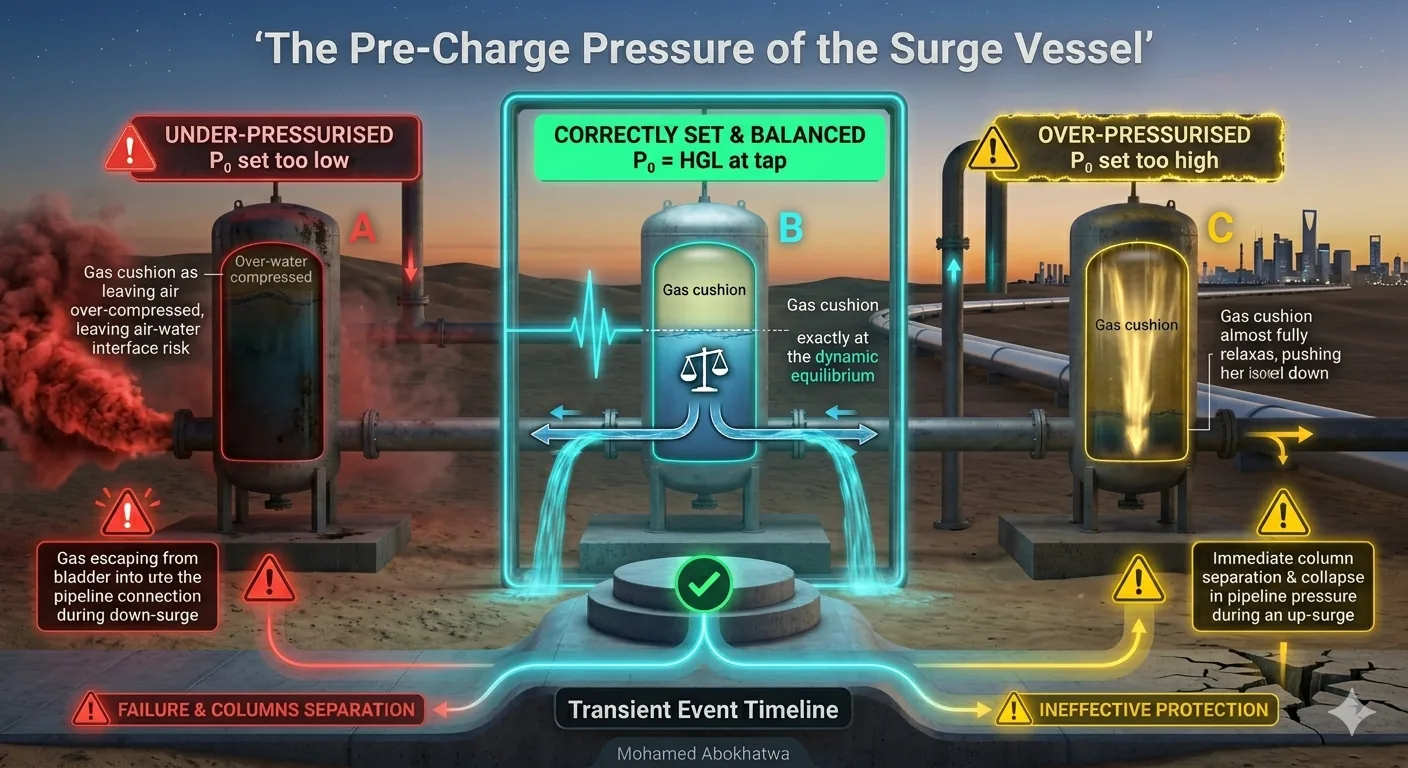
Of all the numbers on a surge vessel datasheet, the one that decides whether the vessel actually protects the pipeline is also the one most often set wrong. It is rarely the shell volume. On a bladder or diaphragm vessel it is the pre-charge; on an air-over-water vessel it is the gas volume, held by the water-level set point. Both numbers mean something only in absolute pressure, and on the reference main used here the gas in a vessel at the pump discharge sits at 9.35 bar abs — a pressure the line imposes, not one anyone sets.
The reference system and the model
A 12 km DN800 ductile iron K9 transmission main [1] carries 2,520 m³/h (1.39 m/s) at a wave speed of 1,050 m/s. The steady HGL is 85.0 m at the pump and 44.8 m at the delivery reservoir, on a flat profile. The pipe class is PN16 with 136 m allowable [2], the design minimum is +3.0 m anywhere on the line, and the gas law exponent is 1.2. The load case is the loss of power to all pumps at once, modelled as an instant stop of the pump flow behind an ideal check valve, with no pump inertia. Unprotected, the downsurge takes the line to vapour pressure, and the collapse of the cavities drives the maximum to 165 to 190 m — above PN16 whichever way it is modelled.
Every transient figure below comes from a method-of-characteristics model with a vapour cavity model [3], [4], cross-checked with a gas cavity model and an independent second code. None of it is HAMMER output. Where the line reaches vapour, the spike that follows depends on how the cavity is represented [5], so those maxima are given across both cavity models. The lesson for design: never rely on a collapse peak; protect the downsurge. A project analysis must still be run in HAMMER, or an equivalent package, on the real profile.
1. What pre-charge is — and what it is not
"Pre-charge pressure" is used loosely, on site and in specifications, for any gas pressure in any vessel. It should be kept for one thing on one type of vessel.
Bladder and diaphragm vessels: the pre-charge is a setting
A flexible bladder or diaphragm separates the gas from the water. Before the vessel sees any water, its gas side is charged, normally with nitrogen, to the pre-charge Ppre: the gas pressure with the vessel empty of water. At that moment the gas fills the whole shell. When the line comes up to pressure, water enters and squeezes the bladder until the gas pressure equals the line pressure at the tap. The gas volume in service follows from the shell, the pre-charge and the line pressure: set the pre-charge and you have set the gas volume — until the pre-charge changes [6].
Air-over-water vessels: there is no pre-charge
An air-over-water vessel has no membrane: compressed air sits directly on the water. There is nothing to pre-charge, and the gas pressure is not a setting at all — in steady operation it equals the line pressure at the tap. What the operator sets is the gas volume, through the water level: a compressor adds air and a level control holds the surface within a band. Air dissolves under pressure, so that band is defended continuously, not set once [7].
| Bladder or diaphragm | Air-over-water | |
|---|---|---|
| What you set | Pre-charge, with the vessel empty of water | Gas volume, through the level set point |
| What follows | Gas volume in service = shell × Ppre / P0 | Gas pressure = line pressure at the tap |
| What holds it | The membrane and the gas valve | Compressor, level instruments and alarms |
| How it drifts | Permeation and leakage lower it; temperature moves it | Air dissolves; the vessel slowly waterlogs |
| How you check it | Water side isolated and drained to zero pressure | Level reading, in service |
In service both types carry the same gas pressure, 9.35 bar abs (8.33 bar g) at the pump on this main: the working pressure of an air-over-water vessel, and the pressure a bladder’s pre-charge is squeezed up to — never the pre-charge itself.
2. The physics — two gas laws, one pressure basis
The gas in a surge vessel goes through two very different processes, and each has its own law [3], [8].
Pre-charge and steady service are linked isothermally. The pre-charge is set with the gas at ambient temperature, and in steady service the gas has long since returned to ambient, however quickly the line first compressed it. Equal temperatures at the two states give:
A pump trip is fast. The gas expands with little time to take heat from its surroundings, and cools as it does. Design uses a polytropic law with an exponent between the isothermal 1.0 and the adiabatic 1.4; this series uses 1.2 [8]:
Both laws are written in absolute pressure, because a gas does not know what the local atmosphere is:
The design minimum of +3.0 m becomes 3.0 + 10.33 = 13.33 m abs, or 1.31 bar abs. Between that and the steady 95.33 m abs, a volume of gas can grow at most (95.33 / 13.33)1/1.2 = 5.152 times before the vessel's own pressure is down at the design minimum. That ratio carries the whole calculation, and it is right only when both pressures are absolute. (The 10.33 m is the standard atmosphere used throughout this series; on a high site, use the local value.)
3. The unit traps — worked on the reference duty
The transient model sizes an air-over-water vessel with a free DN400 connection on this line at 3.08 m³ of gas at the steady HGL, expanding to 15.30 m³ in the trip: 12.22 m³ of water delivered to the line. The method is in Sizing the Hydropneumatic Surge Vessel. A closed-form hand check turns the question round [9]: what gas volume delivers 12.22 m³ of water between the steady pressure and the design minimum?
The same formula gives very different answers depending on how its two pressures are written:
| Pressures used | P0 | Pmin | Expansion ratio | Gas V0 (m³) | Against the correct answer |
|---|---|---|---|---|---|
| Absolute, both in metres | 95.33 m abs | 13.33 m abs | 5.152 | 2.94 | Correct |
| Gauge heads (atmosphere forgotten) | 85.0 m | 3.0 m | 16.23 | 0.80 | 3.7× too small |
| Metres abs over bar abs | 95.33 | 1.31 | 35.6 | 0.35 | 8.3× too small |
| Bar gauge over metres abs | 8.33 | 13.33 | 0.676 | no answer | Ratio below 1 |
| Model HGL read as a head, tap at 350 m (illustrative) | 445.33 m abs | 13.33 m abs | 18.62 | 0.69 | 4.2× too small |
Forgetting the atmosphere is the trap that survives review, because 0.80 m³ looks plausible. It is 3.7 times too small: the gauge ratio says the gas can expand sixteen-fold, when in absolute terms it can expand about five-fold. Mixed units are not much safer. One mix gives a ratio below one; the other gives an implausible 36-fold expansion and a plausible-looking 0.35 m³. Both are caught only if someone checks the ratio, not just the final volume. The hand answer, 2.94 m³, is also not the model’s 3.08 m³: the closed form draws the gas down exactly to the design minimum and ignores wave action. It checks the model; it does not replace it.
The datum trap
A hydraulic model reports HGL as an elevation above its datum, not as a pressure. On this flat reference line, laid at datum, the two coincide. Put the tap, purely for illustration, 350.0 m above datum: the model reports an HGL of 435.0 m, the head at the tap is still 85.0 m, and reading the HGL as a head gives 43.66 bar abs and a gas volume 4.2 times too small. Strictly, the gas pressure head is the HGL minus the elevation of the water surface in the vessel: the tap elevation plus the level above the tap. The runs here put that surface at the pipe; each metre of level above it takes about 1 % off the 95.33 m abs.
Where the tap is
A vessel "at the pump" is connected a few metres to a few tens of metres downstream of the discharge header. The steady HGL here falls by 40.2 m over 12 km, so in absolute terms a tap 50 m out sees 0.2 % less gas pressure than the pump, one at 500 m 1.8 % and one at 2 km 7.0 % (Figure 1). Friction to the tap is not where settings go wrong; units and datum are. A tap kilometres away is no longer a vessel at the pump, and is sized again by running the transient.
Pump head is not the gas pressure
The pumps here develop 80 m of total dynamic head from a 5 m suction head, so the discharge HGL is 85 m. Taking the TDH as the gas pressure understates it by about 5 % in absolute terms (8.86 instead of 9.35 bar abs) and leaves a back-calculated bladder charge about 5 % short of gas; with a suction lift the error changes sign. Only the steady pressure head at the tap belongs in the gas calculation.
Interactive: the steady gas pressure along the line
Figure 1 — Steady HGL along the 12 km main (left axis; laid at datum, so HGL equals pressure head) and the steady gas pressure of a vessel tapped there (right axis, (h + 10.33) / 10.20). The badge turns amber beyond 500 m, a judgement: past that the tap is no longer at the pump and is checked by a transient run.
4. Worked example A — a bladder vessel with a fixed 25 m³ shell
Take a bladder vessel with a 25 m³ shell at the pump, on a free DN400 connection (loss coefficient 0.5 both ways), and change only the pre-charge, written as a fraction f of the absolute design minimum: Ppre = f × 13.33 m abs. Isothermal charging fixes the gas in service, V0 = 25 × Ppre / 95.33. Each row is a full transient run of the pump trip at n = 1.2.
| Pre-charge fraction f | Pre-charge (bar abs) | Pre-charge (bar g) | Gas in service (m³) | Line minimum (m) | Line maximum (m) | Outcome |
|---|---|---|---|---|---|---|
| 0.5 | 0.65 | −0.36 | 1.75 | −5.0 | 137.8 | Fails both limits |
| 0.7 | 0.91 | −0.10 | 2.45 | −0.4 | 130.8 | Fails +3.0 m |
| 0.9 | 1.18 | +0.16 | 3.15 | +3.3 | 130.5 | Meets both |
| 1.0 | 1.31 | +0.29 | 3.50 | +4.5 | 127.5 | Meets both |
| 1.5 | 1.96 | +0.95 | 5.24 | +8.5 | 105.8 | Meets both in the trip; above the design minimum |
| 2.0 | 2.61 | +1.60 | 6.99 | +11.7 | 96.8 | Meets both in the trip; 1.27 m³ of water left |
| 2.5 | 3.27 | +2.25 | 8.74 | −9.8 (vapour) | 96–97 (both cavity models) | Vessel empties |
| 3.0 | 3.92 | +2.91 | 10.49 | −9.8 (vapour) | about 92 (both cavity models) | Vessel empties |
Too low a pre-charge crushes the gas into too small a volume at operating pressure. At f = 0.5 there are only 1.75 m³ of gas in service: the vessel runs out of expansion, the line minimum reaches −5.0 m, and the small, stiff cushion lets the upsurge reach 137.8 m, over the 136 m allowable too. At f = 0.7 the minimum is still −0.4 m; only from about f = 0.9 does this shell meet +3.0 m. Those verdicts are for n = 1.2: at n = 1.4 the same shell gives −0.7 m at f = 0.9 and only +0.9 m at f = 1.0.
Note the gauge column: f = 0.5 and 0.7 are below atmospheric pressure, so no one sets them on purpose, but the same small gas volume arrives by other routes. A vessel commissioned without its pre-charge, its bladder closed on air at atmospheric pressure, is f = 0.775: 2.71 m³ of gas and a line minimum of only +1.1 m in the same model. A slow leak walks the vessel up the table in the same way.
A pre-charge above the minimum still works in a fast trip. At f = 1.5 the minimum is +8.5 m and the maximum 105.8 m, better than any lower pre-charge: the gas cools as it expands, to 18.8 m abs, below the 20.0 m abs pre-charge, without the bladder reaching the shell. In a slow pressure fall, with the gas at ambient temperature, the bladder fills the shell at 20.0 m abs (+9.7 m) and closes onto the outlet, and the vessel delivers nothing below that. On this line that happens only when the main is drained or held below +9.7 m (with the pumps stopped, the main settles at the 44.8 m reservoir level), but each time the membrane is pressed onto its outlet. That is why practice and manufacturers’ guidance keep the pre-charge below the lowest operating pressure the vessel must serve — a judgement about slow events and membrane life that a pump-trip run will not show.
Too high, and the vessel fails abruptly. At f = 2.0 it still passes, +11.7 m and 96.8 m, with only 1.27 m³ of water left at full expansion; at f = 2.5 the shell empties, the line reaches vapour and the collapse-driven maximum is 96 to 97 m across the two cavity models (about 92 m at f = 3.0). More gas helps right up to the moment the water runs out. Both models treat an empty shell as a dead end, which a bladder closing onto its outlet makes physical; an air-over-water vessel does not (section 5).
Interactive: one shell, eight pre-charges
Figure 2 — Lowest and highest head anywhere on the main after the trip, 25 m³ bladder vessel, free DN400 connection, n = 1.2, at the eight pre-charges that were run. The runs are evenly spaced, not to scale, and deliberately not joined: nothing was run between them, and the vessel passes at f = 2.0 but empties at f = 2.5 (crosses). After emptying, the maximum follows a cavity collapse; the two cavity models agree within 1 m.
Shell and pre-charge are one decision
Turn the example round. The transient model asks for 3.08 m³ of gas at the steady HGL, and a bladder can only deliver that through shell and pre-charge together: Vshell = 3.08 × 95.33 / Ppre. The lower the pre-charge, the larger the shell.
| Pre-charge fraction f | Pre-charge (m abs) | Pre-charge (bar g) | Shell needed (m³) | Against air-over-water, 19.1 m³ |
|---|---|---|---|---|
| 0.5 | 6.67 | −0.36 | 44.1 | +131 %, below atmospheric |
| 0.6 | 8.00 | −0.23 | 36.7 | +92 %, below atmospheric |
| 0.7 | 9.33 | −0.10 | 31.5 | +65 %, below atmospheric |
| 0.8 | 10.66 | +0.03 | 27.5 | +44 % |
| 0.9 | 12.00 | +0.16 | 24.5 | +28 % |
| 0.95 | 12.66 | +0.23 | 23.2 | +21 % |
An air-over-water vessel carries the same duty in 19.1 m³: its compressor puts the gas in at working pressure, and the shell keeps 20 % of its volume as water at maximum expansion. A bladder at f = 0.9 needs 24.5 m³, 28 % more, which is why the 25 m³ shell above just passes there. The pre-charge that can be set by ordinary charging and still sits at or below the minimum lies between atmospheric (f = 0.775) and 0.29 bar g (f = 1.0), and each value needs its own shell: 28.4 m³ at atmospheric, 24.5 m³ at 0.16 bar g. Choose the pre-charge with the shell. The type decision this feeds is in Bladder, diaphragm or air-over-water vessel.
Interactive: the shell a pre-charge buys
Figure 3 — Bladder shell needed to hold the 3.08 m³ of gas the transient model asks for at the steady HGL, by isothermal charging: Vshell = 3.08 × 95.33 / (f × 13.33). Dashed green: the 19.1 m³ air-over-water shell for the same duty. Dotted grey: atmospheric pre-charge.
5. Worked example B — an air-over-water vessel with a fixed 20 m³ shell
Now the reference vessel used across this site: a 20 m³ air-over-water shell at the pump with a differential DN400 connection, loss coefficient 2 out and 10 in (see the differential orifice). There is no pre-charge to choose; the gas is at 9.35 bar abs whatever you do, and the only number is how much of it there is. Seven settings, n = 1.2:
| Gas in service (m³) | Share of the shell | Line minimum (m) | Line maximum (m) | Water left at full expansion (m³) | Outcome |
|---|---|---|---|---|---|
| 2.00 | 10.0 % | −3.8 | 126.4 | 7.47 | Fails +3.0 m |
| 2.50 | 12.5 % | −0.7 | 124.3 | 6.35 | Fails +3.0 m |
| 3.00 | 15.0 % | +1.9 | 123.5 | 5.09 | Fails +3.0 m |
| 3.50 | 17.5 % | +4.3 | 119.2 | 3.83 | Meets both — reference design |
| 4.50 | 22.5 % | +7.2 | 106.8 | 1.52 | Meets both, small reserve |
| 6.00 | 30.0 % | −9.8 (vapour) | about 96 (both cavity models, empty shell as a dead end) | 0 | Vessel empties |
| 8.00 | 40.0 % | −9.8 (vapour) | about 88 (both cavity models, empty shell as a dead end) | 0 | Vessel empties |
Both cavity models treat an empty shell as a dead end, so the two emptied maxima assume the outlet simply stops delivering. A real air-over-water vessel would pass air into the main, changing the pressures and leaving air pockets: those figures show that the setting fails, not what the peak would be.
There is a window. Too little gas runs out of expansion before the downsurge is over: below 3.22 m³ the line falls under +3.0 m. Too much gas runs out of water: at the upper edge the expanding gas just reaches the shell volume, and beyond it the vessel empties. At n = 1.2 this hydraulic window is 3.22 to 5.21 m³, 16 to 26 % of the shell.
The set point, its control band and both gas alarms must fit inside it, and two things leave far less room than it suggests. The first is the water reserve. Keep a fifth of the shell as water at full expansion, the reserve this series sizes shells with, and the band shrinks to 3.22 to 3.43 m³, about 1 % of the shell. The reference 3.5 m³ sits just above it with 3.83 m³ of water (19 %), only 0.28 m³ above the lower edge — the edge the vessel drifts towards on its own as air dissolves, so the low-gas alarm must be tight. The 4.5 m³ row looks better on both envelopes but leaves 1.52 m³ of water; on that side, overfilling with air, a failed level control and gas-law uncertainty all push towards emptying.
The second is the gas law exponent, which moves both edges. At n = 1.4 the window is 4.16 to 5.87 m³ and the reference 3.5 m³ setting gives only +0.3 m; at n = 1.0 it is 2.33 to 4.46 m³, and the 4.5 m³ setting empties. Only 4.16 to 4.46 m³ passes at all three exponents, and at n = 1.0 the vessel is then within 0.7 m³ of empty. The sensitivity is part of choosing the set point, not an afterthought; where it has to pass too, a band that narrow argues, in our judgement, for a larger shell rather than a finer level control.
Finally, forget the "typical" gas ratio. A rule of 40 to 50 % gas is squarely on the failing side here — at 30 % this vessel already empties. The gas share is an outcome of sizing one line, one vessel and one connection, not a rule to start from.
Interactive: the gas setting in the trip
Figure 4 — Pressure head at the pump discharge after the trip, 20 m³ air-over-water vessel, differential DN400 connection, n = 1.2: the selected setting (bold) against 2.00 and 6.00 m³. The readouts are the envelope over the whole line, whose minimum is often reached kilometres from the pump. Emptied settings: the maximum assumes a dead-end outlet and shows only that the setting fails. Amber verdict: meets both limits with less water in reserve than the reference design.
6. Setting it up in Bentley HAMMER
In HAMMER both vessel types are the same element, the Hydropneumatic Tank; what differs is the property that carries the design number [10]. Field names differ slightly between versions, so read the names below as descriptions and check the units against each field. The general workflow is in the HAMMER transient workflow and HAMMER transient tips.
- Build the line and its boundaries. Pipes with 1,050 m/s in the wave speed field (the Wave Speed Calculator derives it from the pipe data; see wave speed), the delivery Reservoir at its level, and the pumps.
- Set up the trip. On each Pump, a pump trip (shut down) at the start of the run, the inertia of pump and motor, and the check valve on the pump with its closure. This article’s runs are an instant stop behind an ideal check valve, which a very small inertia approximates. Real inertia keeps the pumps delivering for a few seconds and, on this line, softens the downsurge: enter it for the project run and expect different numbers.
- Place the vessel. A Hydropneumatic Tank at the tap node, its elevation consistent with the pipe and the drawing, tank volume equal to the shell (25 m³ in example A, 20 m³ in B).
- Air-over-water: enter the initial gas volume. Leave the bladder option off and enter the gas volume at the level set point, 3.5 m³ for the reference vessel. Do not try to set a pressure: it follows from the steady-state HGL at the node, 9.35 bar abs here.
- Bladder or diaphragm: enter the pre-charge. Switch on the bladder option and enter the pre-charge as the preset gas pressure, reading whether the field wants absolute or gauge: at f = 0.9 that is 12.00 m abs or only +1.67 m gauge. Let the steady state set the initial gas volume.
- Gas law exponent and connection. Exponent 1.2. Inlet orifice diameter 400 mm; minor loss coefficient 0.5 with a ratio of losses of 1 for example A, and 2 with a ratio of 5 for the differential orifice of example B. Check in your version’s help which flow direction each refers to.
- Check the initial gas volume. Compare the steady-state value with your hand value, 25 × 12.00 / 95.33 = 3.15 m³ for the bladder example, taking the gas pressure as the HGL minus the elevation of the water surface in the vessel. A large difference almost always means the pressure basis or the datum is wrong.
- Transient run options. Run duration 150 s, over six times 2L/a, because the pump-discharge peaks in Figure 4 arrive at roughly 85 to 110 s; vapour pressure and column separation switched on.
- Run the edges, not only the nominal. Air-over-water: initial gas volume at the low-gas and high-gas alarm levels. Bladder: preset gas pressure as specified, after a leak, as left by a technician who bled it while hot, and at atmospheric (never charged). Both: gas law exponent 1.0 and 1.4, which move the window; the trip from every credible operating mode; and the vessel isolated.
- Read what matters. The maximum and minimum head envelopes along the profile against +3.0 m and 136 m, and the time history of gas volume against the tank volume. If the gas ever reaches the tank volume the vessel has emptied: any later maximum is a collapse peak you should not design on, and a real air-over-water vessel would be passing air into the main. Treat an emptied run as a failed setting, whatever peak it reports.
7. Commissioning and field practice
In over 22 years of practice on water transmission projects, I have found that getting the vessel number right on the drawing is the easier half. Keeping it true on site is the harder half, and what undoes it differs by vessel type.
Bladder vessels: pre-charge, temperature and leakage
In service the bladder transmits line pressure to the gas, so a gauge on the gas valve reads line pressure, not pre-charge. The pre-charge can only be checked with the water side isolated and drained to zero pressure. Specify what that needs: an isolation valve, a drain, a way to keep the line protected or out of service, and a gauge that reads to a few hundredths of a bar — the pre-charge at f = 0.9 is only +0.16 bar g. Record the gas temperature with every reading.
The pre-charge is a fixed mass of gas in a fixed volume, so its pressure follows absolute temperature. Set at 20 °C, it reads 318.15 / 293.15 = 8.5 % higher at 45 °C: 12.00 m abs becomes 13.02 m abs, 0.98 of the design minimum instead of 0.90. A technician who bleeds a sun-warmed vessel back to the nameplate value has removed gas. Put the reference temperature on the nameplate and a correction in the O&M manual.
Gas also permeates slowly through the bladder and leaks past valves, so the pre-charge falls over time. Nothing in normal operation shows it; only periodic checks will. The membrane is a wearing part in permanent contact with drinking water and must carry the appropriate approval [11].
Air-over-water vessels: dissolved air and the empty vessel
Air in contact with water under pressure dissolves, so an air-over-water vessel loses gas continuously and slowly waterlogs, drifting towards the low edge of the window, where the reference setting has only 0.28 m³ in hand. That is why it needs a compressor and level control with low-gas and high-gas alarms, not a charge applied once [7]. The other edge matters as much. Overfill the vessel with air, or lose the level control, and a trip can empty it; once the water is gone, air passes into the main, collects as pockets at high points and must be released through the air valves [12]. The level instruments and both alarms are part of the surge protection, not auxiliaries.
8. Design checklist — pre-charge and gas setting
| # | Check item | Priority |
|---|---|---|
| 1 | Vessel type fixed and its design number named: the pre-charge (bladder, diaphragm) or the gas volume and level set point (air-over-water) | Critical |
| 2 | Every gas calculation in absolute pressure, with P (bar abs) = (h + 10.33) / 10.20 written on the calculation sheet | Critical |
| 3 | Steady gas pressure taken from the steady-state model as the HGL minus the elevation of the water surface in the vessel (tap elevation plus level) — not pump TDH, not design pressure | Critical |
| 4 | Bladder: shell and pre-charge chosen together with Vshell = V0 × P0 / Ppre; pre-charge above atmospheric and at or below the lowest pressure the vessel must serve | Critical |
| 5 | Air-over-water: gas window found by transient runs at n = 1.0, 1.2 and 1.4; set point, level band and both alarms inside it, with the water reserve kept | Critical |
| 6 | Steady gas pressure, initial gas volume and the trip checked for every credible operating mode (number of pumps, flow), not only the design duty — a bladder's gas in service rises as the steady pressure falls | Critical |
| 7 | Transient runs at the edges: pre-charge as specified, after a leak, bled while hot and never charged; gas at the low and high alarms; vessel isolated | Critical |
| 8 | Gas volume history checked against the tank volume in every run; an emptied vessel is a failed setting, and no acceptance relies on a collapse peak | Critical |
| 9 | Initial gas volume reported by the model matched against the hand value | Important |
| 10 | Pre-charge reference temperature and correction on the nameplate and in the O&M manual | Important |
| 11 | Pre-charge check provisions specified: isolation valve, drain, gauge resolving hundredths of a bar | Important |
| 12 | Air-over-water: compressor, level instruments, low- and high-gas alarms, and air valves at the high points of the main | Important |
| 13 | Shell designed as a pressure vessel for the highest pressure at the tap [13]; membrane approved for drinking water | Important |
9. Conclusion
"Pre-charge pressure" hides two numbers. On a bladder or diaphragm vessel the pre-charge is a setting, and with the shell it fixes the gas volume for as long as the charge holds. On an air-over-water vessel the gas pressure is whatever the line imposes, 9.35 bar abs at the pump here, and the design number is the gas volume held by the level control.
- Work in absolute pressure. Forgetting the atmosphere undersizes the charge 3.7 times on this duty; mixing bar and metres, or reading an HGL as a head, does worse. Pump TDH is not the gas pressure.
- For a bladder, too low a pre-charge fails the downsurge, one above the minimum lets the bladder close on its outlet whenever the line is drained, and too high a pre-charge empties the shell, abruptly. The pre-charge that can be set and still sits at or below the design minimum lies between atmospheric and 0.29 bar g, and the shell must be sized for the value chosen: 28.4 m³ at atmospheric, 24.5 m³ at 0.16 bar g.
- For air-over-water, the gas volume must sit inside a window: 3.22 to 5.21 m³ in the 20 m³ reference vessel at n = 1.2, only 3.22 to 3.43 m³ with a fifth of the shell kept as water, and moving with the exponent. A gas ratio is an outcome of sizing, not a rule.
- Neither number stays right on its own: temperature and leakage move a pre-charge, dissolution moves a gas volume.
Set the number in absolute terms, prove its window with transient runs, and specify the means to keep it there. The vessel volume only earns its cost when that number is right.
- Wave speed: the number that sets the surge
- The differential orifice: empty freely, refill slowly
- Bladder, diaphragm or air-over-water vessel
- One-way surge tanks at the knee
- Surge relief valves: what a valve at the pump can protect
- Pump inertia and the flywheel
- Choosing surge protection on one pipeline
References
- ISO 2531. Ductile iron pipes, fittings, accessories and their joints for water applications — pipe classes for the DN800 K9 reference main.
- EN 805. Water supply — Requirements for systems and components outside buildings — design pressures and the allowance for surge.
- Wylie, E.B. & Streeter, V.L. Fluid Transients in Systems. Prentice Hall, 1993 — method of characteristics, the air-chamber boundary with a polytropic gas law, column separation.
- Bergant, A., Simpson, A.R. & Tijsseling, A.S. "Water hammer with column separation: a historical review." Journal of Fluids and Structures, 22(2), 2006 — discrete vapour and gas cavity models.
- Simpson, A.R. & Bergant, A. "Numerical comparison of pipe-column-separation models." Journal of Hydraulic Engineering (ASCE), 120(3), 1994 — why collapse-driven pressure peaks depend on the cavity model.
- Thorley, A.R.D. Fluid Transients in Pipeline Systems, 2nd ed. Professional Engineering Publishing, 2004 — surge vessels in practice, bladder and air-over-water types.
- Boulos, P.F., Karney, B.W., Wood, D.J. & Lingireddy, S. "Hydraulic transient guidelines for protecting water distribution systems." Journal AWWA, 97(5), 2005 — protection devices and the operation and maintenance of hydropneumatic tanks.
- Chaudhry, M.H. Applied Hydraulic Transients, 3rd ed. Springer, 2014 — air chambers, isothermal and polytropic gas behaviour.
- Stephenson, D. "Simple guide for design of air vessels for water hammer protection of pumping lines." Journal of Hydraulic Engineering (ASCE), 128(8), 2002 — closed-form checks of air vessel gas volume.
- Bentley Systems. OpenFlows HAMMER product documentation and help — the Hydropneumatic Tank element: bladder option, preset gas pressure, initial gas volume, gas law exponent and connection losses.
- NSF/ANSI/CAN 61. Drinking Water System Components — Health Effects — approval of bladder and diaphragm materials in contact with drinking water.
- AWWA M51. Air Valves: Air-Release, Air/Vacuum, and Combination — releasing air pockets at high points.
- EN 13445 Unfired pressure vessels; ASME Boiler and Pressure Vessel Code, Section VIII, Division 1; Pressure Equipment Directive 2014/68/EU — design of the vessel shell as a pressure vessel.