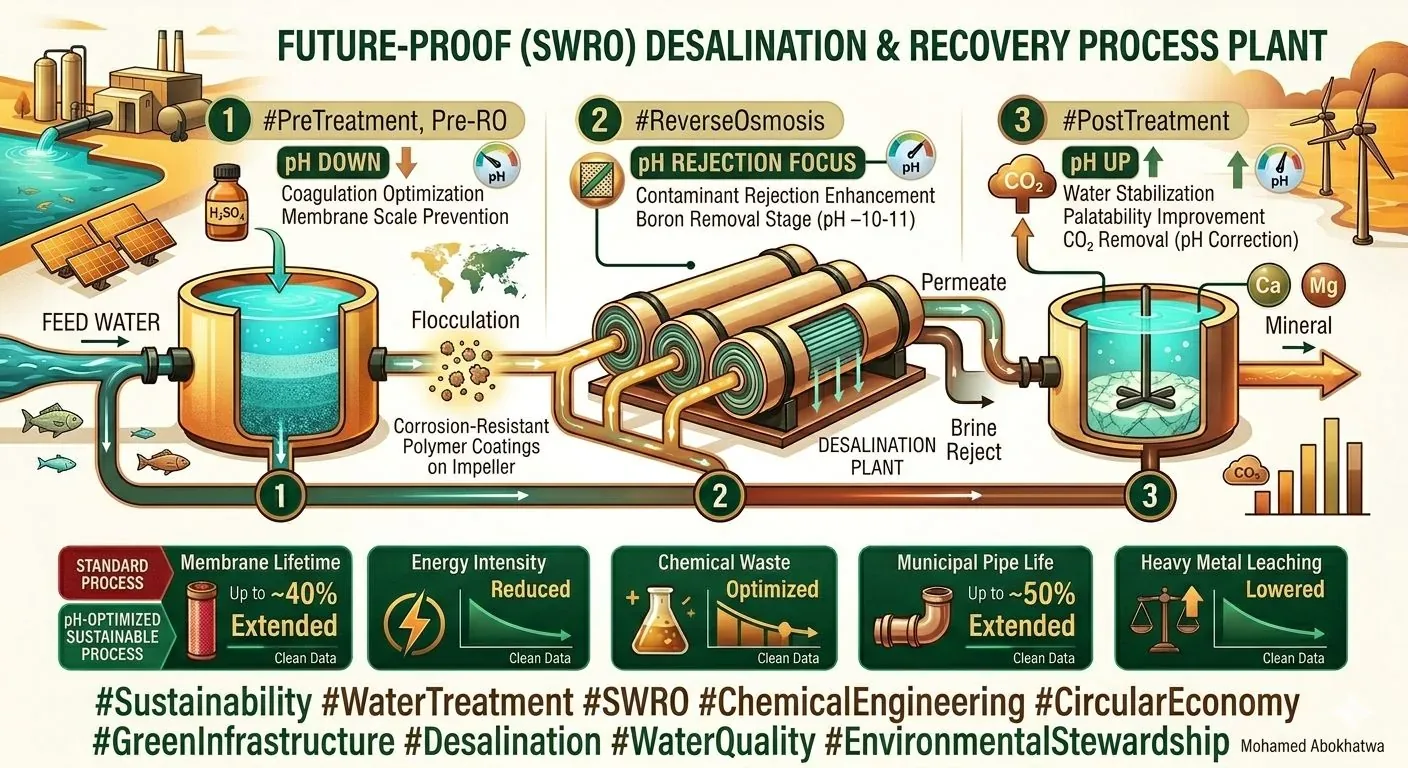
Why pH Is a Strategic Variable
pH is not simply a water quality parameter in SWRO — it is an active engineering tool that determines scaling tendency, membrane rejection performance, corrosion rates in distribution infrastructure, and the long-term sustainability of the entire system. Treating pH management as a chemical dosing afterthought rather than a design input leads to premature membrane replacement, distribution system corrosion, and regulatory non-compliance.
Pre-treatment Stage: Scaling Prevention
Seawater has a natural tendency to precipitate calcium carbonate (CaCO₃) as it is concentrated through the RO process. Acid dosing (sulfuric or hydrochloric acid) before the RO stage lowers pH to 6.5–7.0, shifting the carbonate equilibrium to keep calcium in solution and prevent membrane scaling. The Langelier Saturation Index (LSI) should be maintained below -0.3 at RO design recovery.
RO Stage: Boron Rejection Enhancement
Boron is present in seawater at 4–5 mg/L and is only partially rejected by standard RO membranes at neutral pH. Raising feed pH to 9.5–10.5 converts boric acid (B(OH)₃) to borate ion (B(OH)₄⁻), which is rejected far more effectively — enabling single-pass SWRO to achieve the WHO drinking water guideline of 2.4 mg/L without a second RO pass in favorable conditions.
Post-treatment: Re-mineralization and Corrosion Control
SWRO permeate is aggressive — low pH, low alkalinity, and essentially zero hardness. Without post-treatment, this water will corrode metal pipes and fittings, leaching heavy metals into the distribution system. Calcite contactor or lime dosing raises pH to 7.5–8.0 and adds calcium and alkalinity, creating a slightly positive LSI that forms a protective CaCO₃ film on pipe surfaces.