The Gap Between Theory and Practice
Hydraulic design standards provide the theoretical framework for onshore intake design — but field conditions consistently challenge textbook assumptions. Tidal variations, seasonal algae loads, storm debris, and equipment fouling all create operating conditions that deviate from design assumptions. Robust onshore intake design bridges this gap by building in practical tolerances beyond the theoretical minimums.
Receiving Chamber Design
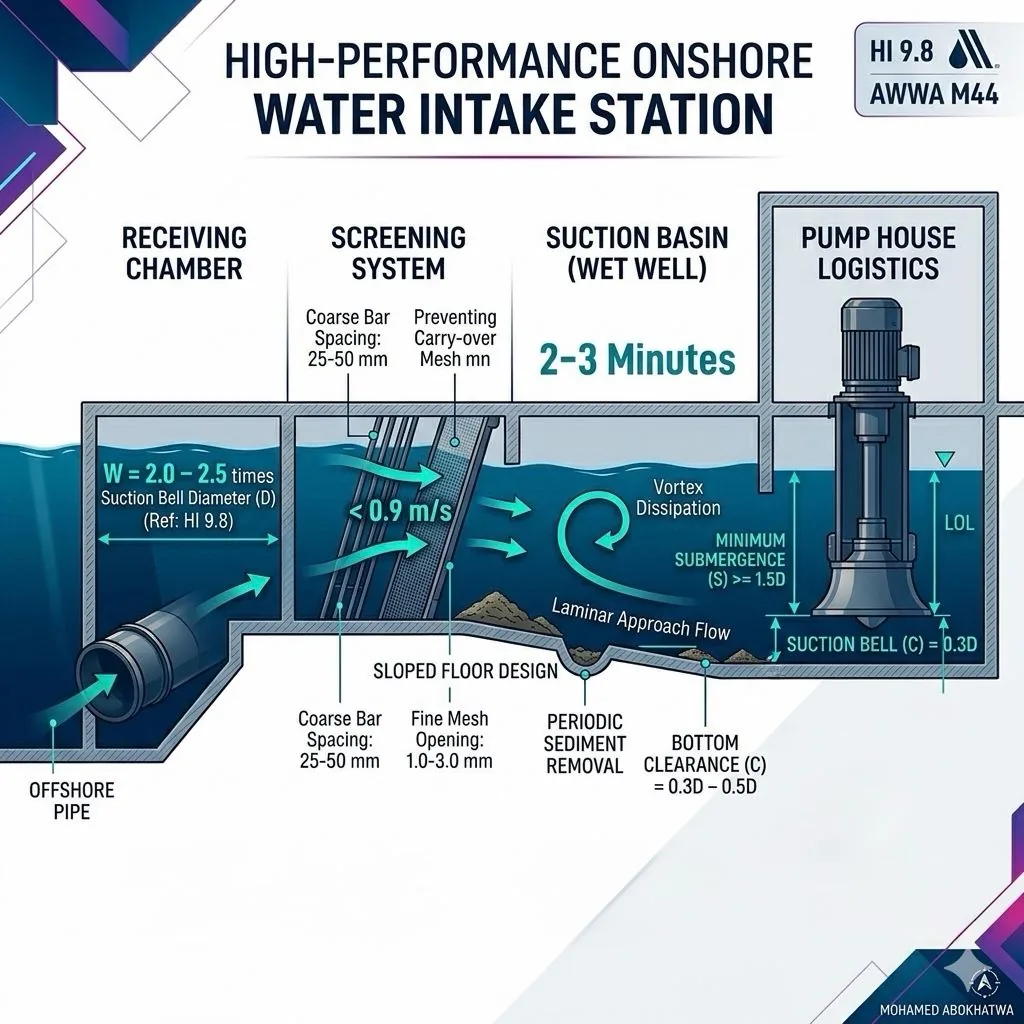
The receiving chamber transitions flow from the offshore pipeline to the pump suction system. Approach velocities must be maintained at 0.3–0.5 m/s per HI 9.8 standards to prevent silt deposition while avoiding turbulence that carries debris to pump suctions. Chamber floors should be sloped or fitted with sump pits at low-velocity zones where sediment will inevitably accumulate, enabling periodic cleanout without dewatering the entire chamber.
Screening System Specifications
Coarse screens with 25–50 mm bar spacing provide primary debris protection. Fine screens with 1.0–3.0 mm mesh openings (traveling band screens or drum screens) provide final protection before pump suctions. Critical sizing parameter: through-screen velocity must remain below 0.9 m/s to prevent fish impingement and minimize differential pressure across the screen — higher velocities force debris against the screen surface, creating rapid blinding.
Suction Basin: The 2.5D Rule
Pump suction basin geometry is critical for vortex prevention. The "2.5D Rule" specifies that the pump cell width should be 2.0–2.5 times the suction bell diameter (D). Minimum water depth above the suction bell must be maintained at 1.5D, and floor clearance should be 0.3D–0.5D — insufficient clearance creates floor vortices; excessive clearance wastes basin volume.
Hydraulic Retention and Vortex Suppression
A minimum hydraulic retention time of 2–3 minutes in the suction basin allows turbulence from screen discharge to dissipate before reaching pump suctions. Anti-vortex plates mounted on the suction bell suppress surface and floor vortices under low water level conditions — essential during tidal drawdown or pump startup when submergence ratios are at their minimum.