The Scale Problem
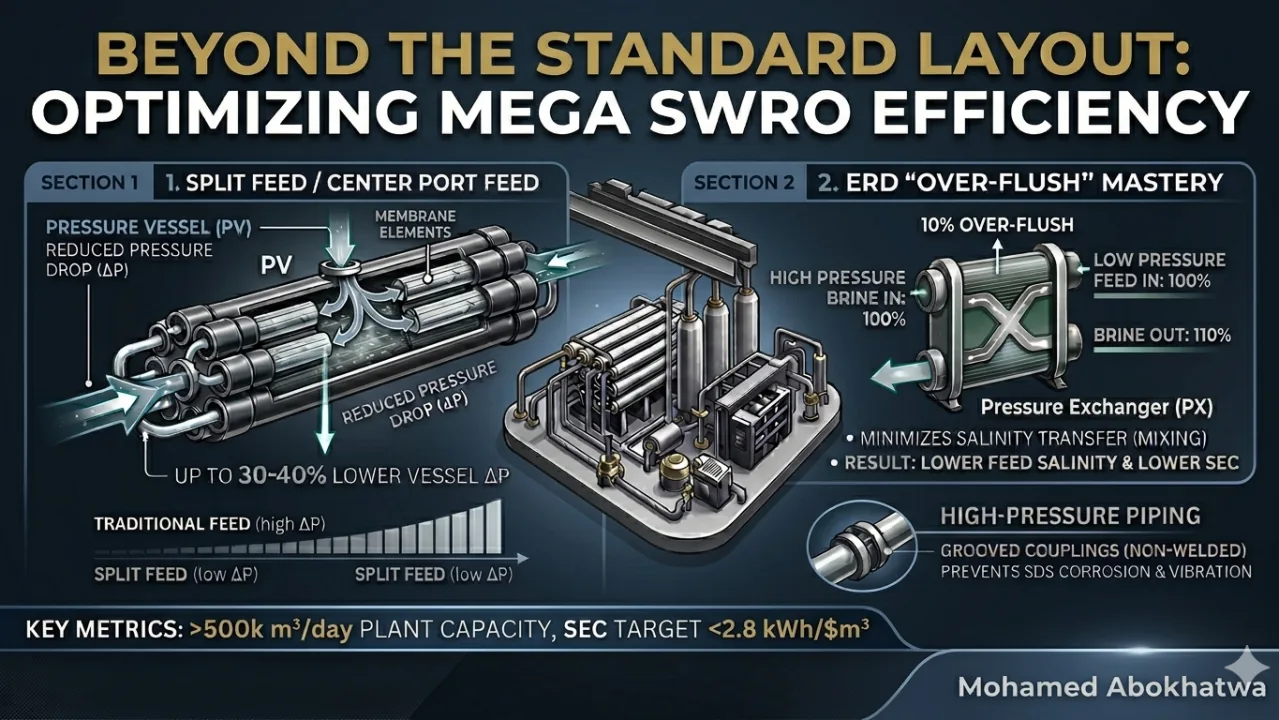
When SWRO capacity exceeds 500,000 m³/day, the engineering challenges become qualitatively different — not just larger versions of standard plants. Hydraulic losses that are negligible at 50,000 m³/day become significant energy penalties at mega-scale. Standard design assumptions no longer hold, and each parameter must be re-evaluated for its contribution to overall system energy consumption.
Center Port Feed Strategy
In standard 8-element pressure vessels, all feed water enters from one end, creating a pressure gradient along the vessel length. Switching to center port feed — where feed enters from the middle — reduces internal pressure drop by up to 0.8 bar per vessel. For a 600,000 m³/day facility, this translates to savings of 2.5–3.0 MW continuously.
Pressure Exchanger Over-flush Optimization
Energy Recovery Devices (ERDs) using isobaric chambers require a controlled over-flush — typically 5–10% excess brine flow — to minimize salinity transfer between high-pressure concentrate and incoming feed. Getting this ratio wrong either wastes energy or allows salt breakthrough, increasing membrane fouling rates and reducing permeate quality.
Material Selection at 70+ Bar
High-pressure components operating above 70 bar require Super Duplex Stainless Steel (e.g., SAF 2507) rather than standard 316L. Rigid welds create heat-affected zones susceptible to pitting corrosion in high-chloride seawater; grooved coupling connections avoid this risk while allowing thermal expansion without stress concentrations. ASTM G48 pitting resistance testing should be specified for all wetted components.
Specific Energy Consumption Target
With proper center port feed, optimized ERD over-flush, and minimized auxiliary loads, a well-engineered mega-SWRO plant should achieve specific energy consumption below 2.8 kWh/m³ — compared to 3.5–4.0 kWh/m³ for poorly optimized systems at the same scale.