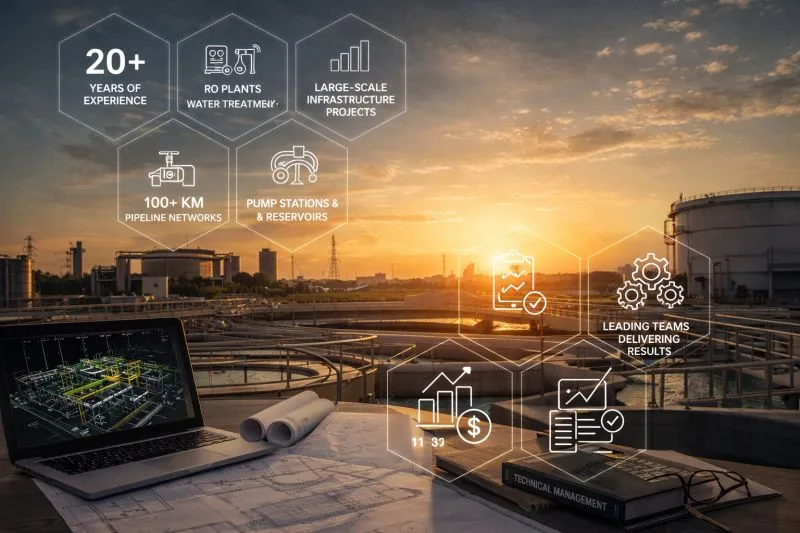
The Real Challenge of Large-Scale Infrastructure
After 22+ years of delivering complex water and infrastructure projects across Saudi Arabia — from 100+ km pipeline networks to 200,000 m³/day treatment facilities — I have learned that technical complexity is rarely the primary challenge. The real difficulty is managing the intersection of design, execution, and stakeholder expectations at scale.
What "At Scale" Actually Means
Working at scale in infrastructure means that every decision has multiplied consequences. A valve specification error on a 10 km pipeline is an inconvenience. The same error on a 400 km system becomes a procurement crisis affecting delivery schedule and commissioning dates across the entire project.
Projects don't struggle because of lack of expertise. They struggle when alignment, ownership, and decision-making are not managed effectively across multidisciplinary teams.
Critical Success Factors
- Aligning Multidisciplinary Teams and Stakeholders: Hydraulic engineers, structural designers, procurement teams, and client representatives must share a common understanding of project objectives and constraints
- Anticipating Risks and Resolving Conflicts Early: Risks identified at concept design cost a fraction of those discovered during construction
- Translating Complex Designs into Coordinated, Buildable Solutions: The interface between design intent and field execution requires engineers who can communicate with both worlds
- BIM as a Coordination Tool: Building Information Modelling transforms design coordination from a series of bilateral conversations into a shared, integrated model
Success Is in How It Is Delivered
The measure of engineering leadership is the ability to take a complex technical challenge, build the team and processes needed to address it, and deliver an outcome that works — for the client, for the contractor, and for the communities the infrastructure serves.