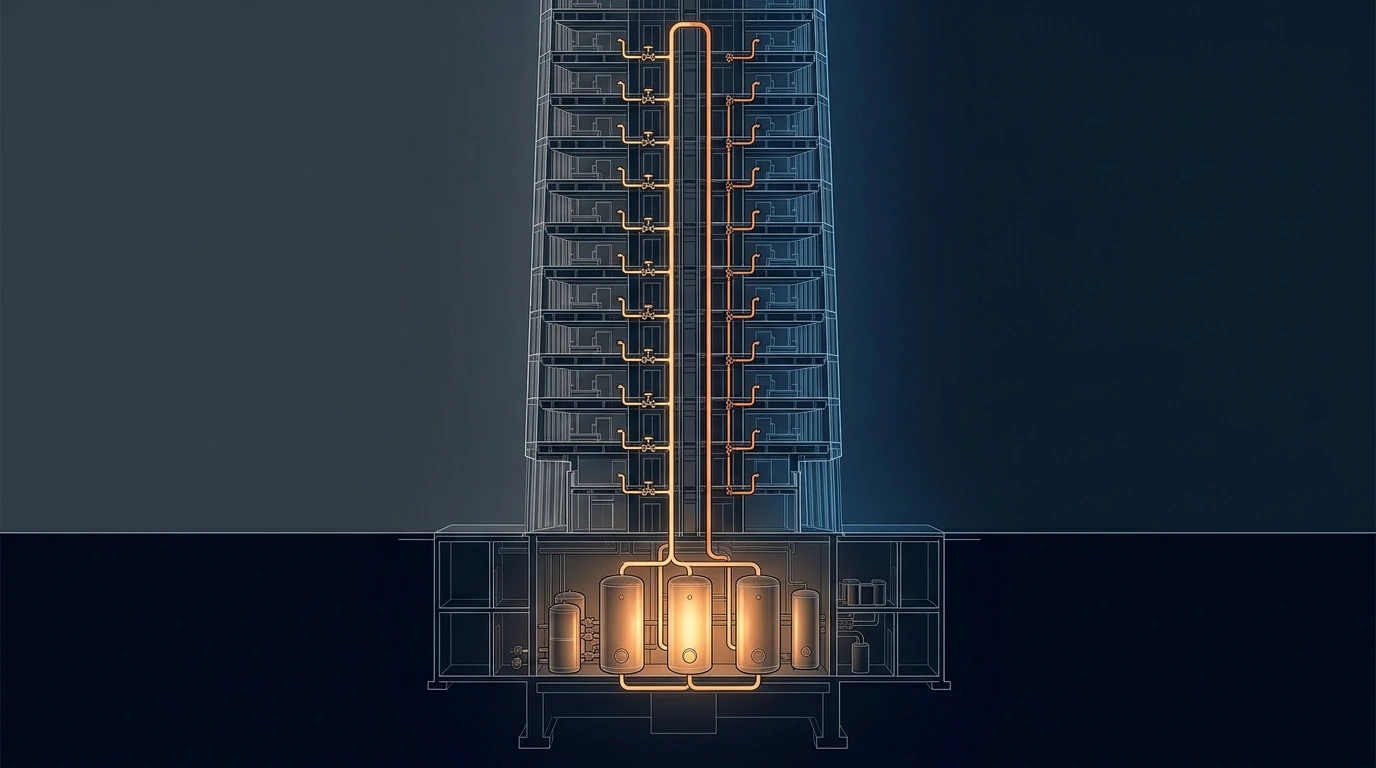
Domestic hot water is the only building service that can kill people through ordinary operation rather than through failure. Legionella does not need a fault, a leak or a fire — it needs lukewarm water and time, and a tall building offers both in abundance: kilometres of pipework, long branches to distant fixtures, and a system that is deliberately kept at the temperature bacteria like best somewhere between the boiler and the tap. The design problem is a genuine conflict. Hot enough to be safe is hot enough to scald, and the temperature that stops growth is the temperature that damages people. Everything else in this article follows from resolving that at the right place in the system.
1 · The central conflict
- Legionella grows between about 20 and 45 °C, thrives around 37 °C, and is killed progressively above 50 °C. Below 20 °C it is dormant.
- Scald risk begins at about 44 °C and becomes severe quickly: a full-thickness burn takes roughly 5 seconds at 60 °C and about a second at 70 °C.
- The resolution is spatial, not thermal. Keep the system hot — storage at 60 °C, return never below 55 °C — and drop the temperature at the last possible moment with a thermostatic mixing valve immediately before the outlet. Never solve it by storing at 45 °C.
- The cold side matters as much. Cold water above 20 °C is a growth medium too, and in a Gulf tower the cold riser sits in a warm shaft next to a hot one. Keeping cold water cold is a real design task, not an assumption.
2 · Interactive: temperature, time and thermal disinfection
Bacterial die-off is logarithmic: a D-value is the time to kill 90 % of the population, and it falls steeply with temperature. This is why the difference between a 55 °C and a 60 °C return is not a 9 % improvement but a factor of seven.
At 55 °C a 4-log kill takes about 56 minutes; at 60 °C it takes 8 minutes; at 50 °C it takes nearly seven hours; and at 46 °C — a return leg that has sagged only a few degrees — it takes well over a day, which in a circulating system means never. That steepness is the entire reason the codes specify 60 °C storage and a 55 °C minimum return rather than a comfortable-sounding 50: the margin is not comfort, it is two orders of magnitude of kill rate. It is also why the number that matters is the temperature at the worst point in the loop, measured, not the boiler set-point.
3 · The recirculation loop — the system's real weak point
A tall building cannot wait for hot water to travel 300 m, so the hot water circulates continuously and returns to the plant. That loop is what keeps the system safe, and it fails in ways that are invisible from the plant room:
- Hydraulic imbalance. Without balancing, the short and easy branches take nearly all the return flow and the long, remote branches — precisely the ones at risk — get almost none and cool below 55 °C. Thermostatic balancing valves on every return branch, which throttle as the branch reaches temperature and so self-balance to temperature rather than to flow, are the single most effective component in the whole system.
- Dead legs. Every length of pipe beyond the circulating loop stagnates. Codes typically limit the dead leg to a few litres or a few metres; the practical rule is to bring the circulation as close to the outlet as the layout allows and to keep the final branch short.
- Undersized return. The return flow only has to carry the loop's heat loss, so it is small — often a fraction of a litre per second — but it must be calculated, not guessed, and it must be checked against the loss of a well-insulated pipe rather than a bare one.
- Infrequently used outlets. A tall residential tower has apartments that stand empty for months. Automatic flushing on a timer, or a managed flushing regime, is part of the design, not the operation.
A 1,200 m loop of DN65 at a decent 0.6 W/m²K loses about 5.1 kW continuously — 45 MWh a year, and needs only 0.25 L/s of return flow to hold a 5 K drop. Two things follow. First, the return flow is tiny, which is exactly why it distributes so badly without thermostatic balancing valves: at these flows a small imbalance starves a branch completely. Second, the standing loss runs 8,760 hours a year and is often larger than any efficiency measure applied to the heat source — so insulation thickness on the circulating loop is a first-order energy decision, not a detail.
4 · Interactive: storage versus instantaneous
Hot water demand is spiky — a hotel's morning peak or a residential tower's evening peak lasts under an hour. You can meet it with raw heater capacity or with stored volume, and in a tall building the trade also involves plant space, structural weight and Legionella risk.
An 8 L/s peak at a 45 K rise is 1,507 kW if met instantaneously. Cover 35 % of it with a 528 kW heater and ride the rest on 6.2 m³ of storage — but that tank weighs 6.2 tonnes on a mechanical floor and, crucially, it must still turn over fast enough to stay safe. The Legionella constraint pushes storage down while the plant-cost constraint pushes it up, and the honest answer in a tall building is usually modest storage with a generous recovery rate, kept at 60 °C, rather than the large buffer tank that a spreadsheet optimum suggests.
5 · Mixing valves, scald protection and the cold side
- Thermostatic mixing valves belong at the outlet, not the plant. A central blending valve serving a whole floor creates a large volume of pipework at 40 °C — the ideal growth temperature — downstream of it. Fit the TMV as close to the fixture as practicable and keep the blended dead leg to a couple of metres.
- Specify the right TMV type and its failsafe: a valve that fails to full hot on loss of cold supply is not acceptable in a healthcare or hotel setting. Require thermal shut-off.
- TMVs need servicing — they scale, and a scaled TMV drifts. Locate every one so it can actually be reached, and schedule them.
- Keep the cold water cold. Insulate cold risers and, in a warm shaft, separate them from hot and heating pipework or provide a ventilated shaft. Where cold water cannot be held below 20 °C — a real problem in Gulf towers with long horizontal runs and warm plant spaces — treat it as a risk requiring its own control measure, not as an unavoidable nuisance.
- Do not run cold water through unventilated risers alongside heating flow and return. It is the commonest cause of warm cold-water in a tall building and it is a coordination decision made in the shaft layout.
6 · Installation & execution tricks
- Insulate to a stated thickness and inspect it — including at valves, flanges, supports and penetrations, which are where it is always missing and where the heat actually escapes.
- Fit a thermometer pocket on every return branch at the point it rejoins the main. Without them, proving 55 °C at the remote branch is guesswork and every future audit is an argument.
- Commission the loop to temperature, not to flow. Set thermostatic balancing valves, then verify the return temperature at every branch with the system at design and again at low draw-off, and record every reading against the branch reference.
- Disinfect systematically and hold the record. Chlorination or thermal disinfection following a written procedure, with samples per zone and per riser, and the results retained — partial disinfection of a zoned system is the classic reason for a second failed clearance.
- Flush before commissioning, and keep flushing until handover. A system that sits full and warm from practical completion to occupation is being incubated. Put a flushing regime in the handover programme with named responsibility.
- Support and expand the hot riser properly. Hot water pipework moves substantially more than cold; provide anchors, guides and expansion devices, and check that insulation and fire-stopping accommodate the movement rather than restrain it.
- Label the water safety plan into the O&M with the temperature regime, the flushing schedule, the TMV service interval and the named responsible person.
7 · The design & installation checklist
- Store at 60 °C, return at 55 °C minimum, blend at the outlet — never compromise the system temperature for scald safety.
- Thermostatic balancing valves on every return branch, and thermometer pockets to prove them.
- Minimise dead legs and bring circulation close to the outlets.
- Calculate the loop loss and return flow on real insulation values, and treat the standing loss as a design target.
- Choose storage for turnover as well as for peak — small and hot beats large and tepid.
- Keep cold water below 20 °C, with shaft layout and insulation designed for it.
- Plan flushing for low-occupancy outlets as a designed feature.
- Commission to temperature and record every branch; disinfect to a written procedure per zone.
- Issue a water safety plan with named responsibility and service intervals.
References & standards
- HSE ACOP L8 — Legionnaires' disease: The control of legionella bacteria in water systems and HSG274 Part 2 (hot and cold water systems) — temperature regime, dead legs, monitoring and written schemes.
- ASHRAE Standard 188 — Legionellosis: Risk Management for Building Water Systems; and ASHRAE Guideline 12 for implementation detail.
- WHO Legionella and the prevention of legionellosis and Water Safety in Buildings — growth conditions, thermal inactivation and building water safety planning.
- CIBSE Guide G — Public Health and Plumbing Engineering and CIBSE TM13 Minimising the risk of Legionnaires' disease.
- BS 8558 and BS EN 806 — design, installation, testing and maintenance of water supply systems including disinfection procedures.
- BS EN 1717 and the relevant TMV standards (BS EN 1111 / 1287, NSF/ANSI / ASSE 1017 and 1070) — mixing valve performance and failsafe requirements.
- ASHRAE Handbook — HVAC Applications, Service Water Heating chapter — demand estimation, storage versus recovery sizing and recirculation design.
- Saudi Building Code SBC 701 plumbing provisions; and ASHRAE Design Guide for Tall, Supertall, and Megatall Building Systems for vertical zoning of service water heating.