Overview
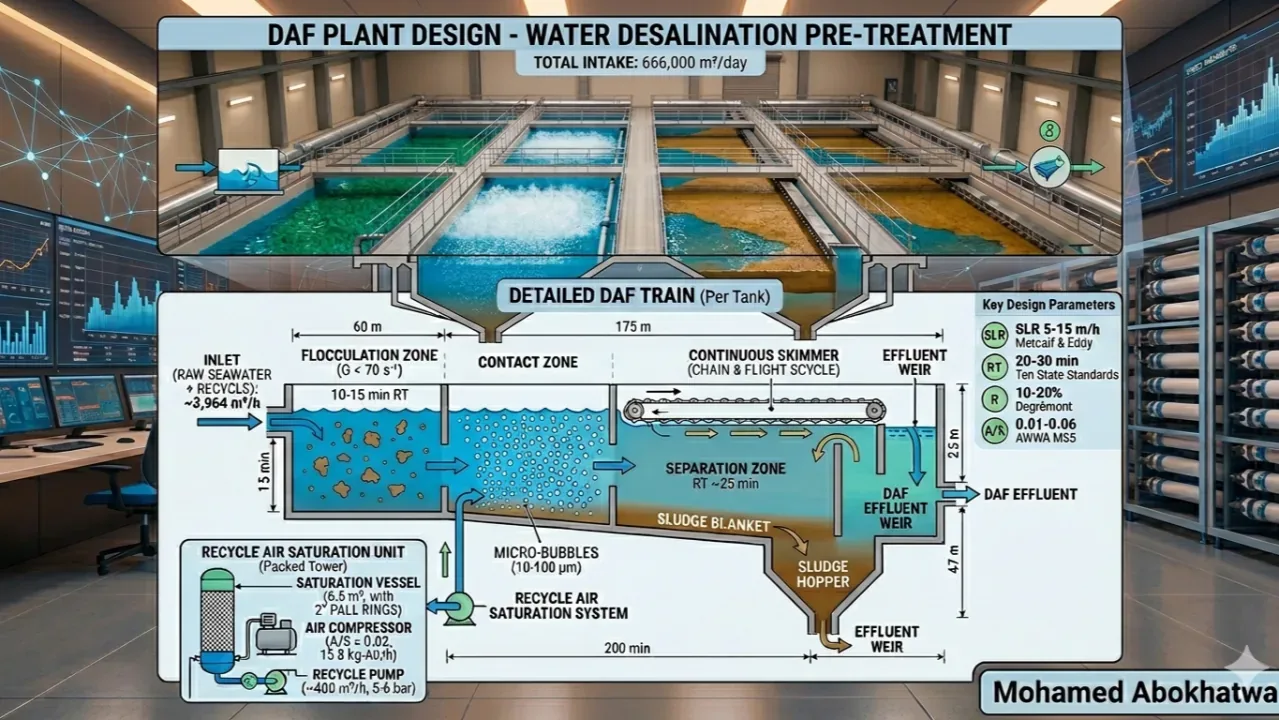
Dissolved Air Flotation (DAF) is a critical pre-treatment technology for large-scale SWRO plants dealing with high-turbidity or algae-laden source water. Unlike conventional sedimentation, DAF forces suspended solids to the surface using micro-bubbles — enabling far higher surface loading rates and more compact system footprints.
Key Design Parameters
- Surface Loading Rate (SLR): 5–15 m/hr depending on water quality and coagulant effectiveness
- Retention Time (RT): 20–30 minutes in the flotation zone
- Recycle Ratio: 10–20% of total influent flow returned as pressurized recycle
- Air-to-Solids Ratio (A/S): 0.01–0.06 — the primary driver of flotation efficiency
Saturation Vessel Design
The saturation vessel dissolves air into the recycle stream at 4–6 bar pressure using packed bed internals (e.g., Pall Rings). Proper vessel sizing ensures adequate air dissolution without channeling or carry-over into the flotation tank, which can disrupt the micro-bubble distribution at the release nozzles.
Case Study: 300,000 m³/day Facility
At mega-scale, multi-train DAF configurations are essential. For a 300,000 m³/day plant, a typical arrangement uses 6–8 DAF trains operating in parallel with cross-connection headers, allowing individual trains to be isolated for maintenance without impacting overall production. Scraper mechanisms must be engineered for high-load scenarios where float accumulates rapidly during algal bloom events.
Polymer Dosing & Floc Management
Effective DAF performance depends on upstream coagulation-flocculation. Optimizing polymer type and dosage — typically cationic polyacrylamide at 0.5–2.0 mg/L — creates the right floc size for micro-bubble attachment. Over-dosing creates dense floc that sinks; under-dosing produces floc too small to float efficiently.