The Double-Edged Sword
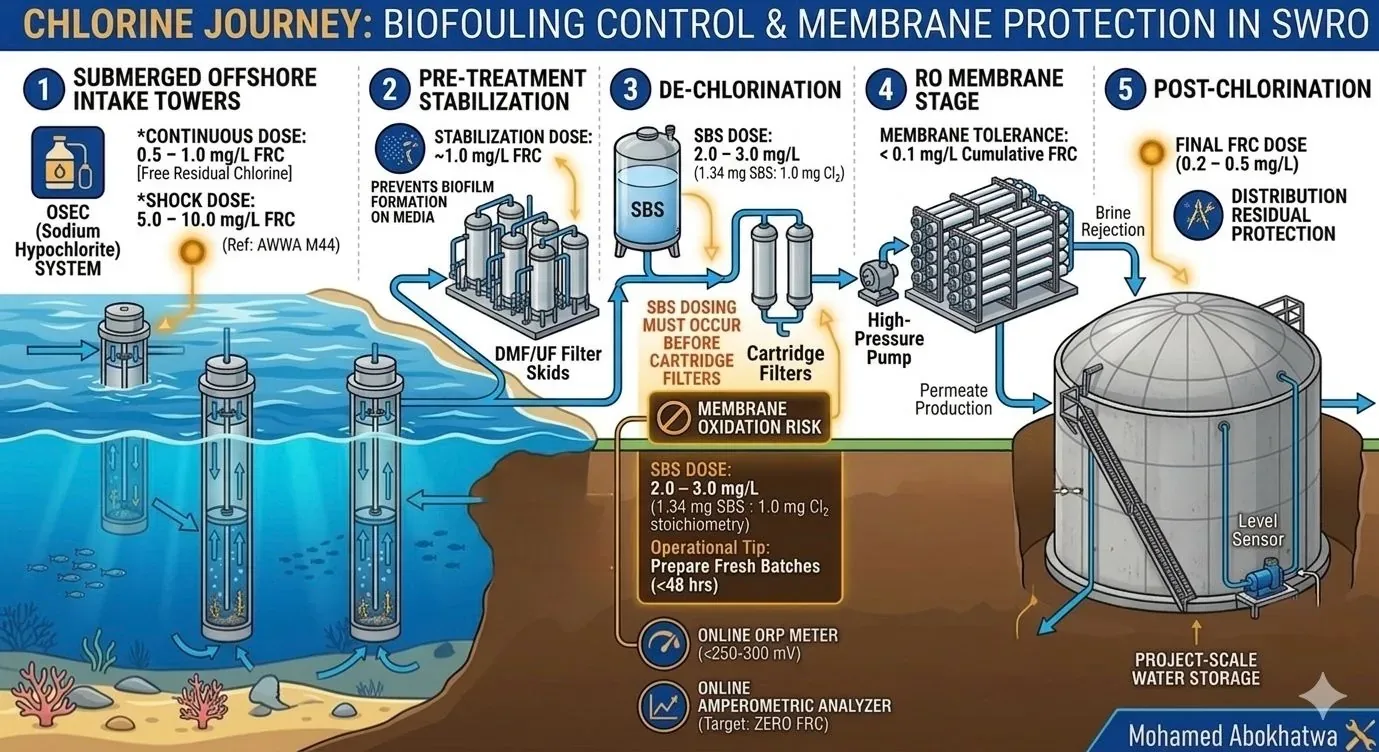
Chlorine is simultaneously the most effective and most dangerous chemical in an SWRO plant. It is essential for preventing marine biofouling in intake systems and pre-treatment infrastructure — yet even trace concentrations above 0.1 mg/L will irreversibly oxidize polyamide RO membrane surfaces, causing permanent permeability damage.
On-Site Generation via Electro-Chlorination
Modern SWRO plants generate sodium hypochlorite on-site by electrolyzing a dilute seawater stream. This eliminates the hazards of transporting bulk chlorine and provides a continuous supply at controlled concentrations. Typical operating targets are 0.5–1.0 mg/L free residual chlorine in the intake pipeline, with periodic shock doses of 5.0–10.0 mg/L to manage biofilm accumulation.
De-chlorination: The Critical Protection Step
Before feed water reaches the RO membranes, all residual chlorine must be removed. Sodium bisulfite (SBS) is the standard de-chlorination agent, dosed at a ratio of approximately 2.0–3.0 mg SBS per 1.0 mg Cl₂. Verification requires dual instrumentation — ORP (Oxidation-Reduction Potential) meters for continuous monitoring and amperometric analyzers for trace chlorine detection below 0.05 mg/L.
Post-Chlorination for Distribution
After the RO process, permeate is re-chlorinated to 0.2–0.5 mg/L free residual chlorine before entering the distribution network, per WHO drinking water quality guidelines. This post-treatment step must be balanced against corrosion risk in the distribution piping — particularly important for galvanized or copper distribution systems where excess chlorine can accelerate corrosion and metal leaching.