Introduction
Check valves are among the most frequently overlooked components in surge analysis — yet they can function as both protective devices and failure points. How you model a check valve in Bentley HAMMER directly translates into procurement specifications and installation requirements. The decision made in the model is worth thousands in cost implications.
1. Modeling Logic Linked to Procurement Specs
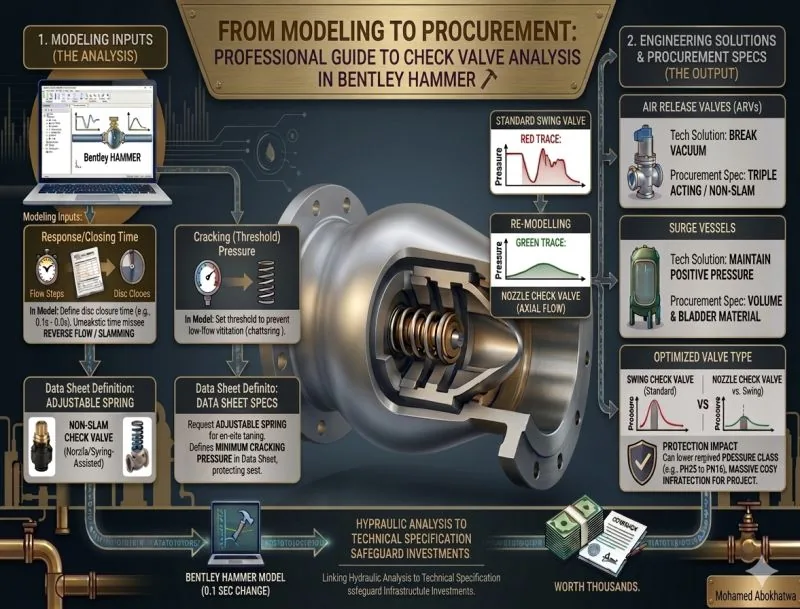
Closing Time
Defines the prevention window for reverse flow slamming. A check valve that closes too slowly allows significant reverse flow before disc seating — generating water hammer upon closure.
Specification Recommendation: Specify a Nozzle Check Valve for its short stroke, or a Spring-Assisted model to ensure rapid disc closure before significant reverse flow develops.
Cracking Pressure
Ensures disc stability during low-flow conditions. A valve that opens too easily may chatter; one that opens too late creates excessive pressure drop.
Specification Detail: Request Adjustable Spring in the Data Sheet for site-level adjustments during commissioning.
2. Managing Negative Pressure Risks
When pumps trip, systems risk hitting vapor pressure (~−1.0 bar gauge), triggering:
- Column separation leading to cavitation implosion
- Pipe buckling in large-diameter, thin-walled pipes (particularly HDPE and GRP)
Check valve closure timing must be coordinated with air valve admission capacity to prevent these outcomes.
3. Engineering Solutions as Procurement Decisions
| Protection Device | Key Specification Detail |
|---|---|
| Air Release Valves (ARVs) | Specify Triple Acting / Non-Slam with Surge Arrestor Device |
| Surge Vessels (Bladder Tanks) | Specify bladder material (EPDM or Butyl) matched to transient response speed |
| Check Valves | Closing time, cracking pressure, adjustable spring — all in data sheet |