Introduction
Unlike buried pipelines, above-ground systems are treated as structural beams. They must resist environmental loads (wind, seismic), thermal expansion, and internal hydraulic forces without the continuous support of soil. This requires rigorous analysis of support spacing, thermal stress, and anchor design.
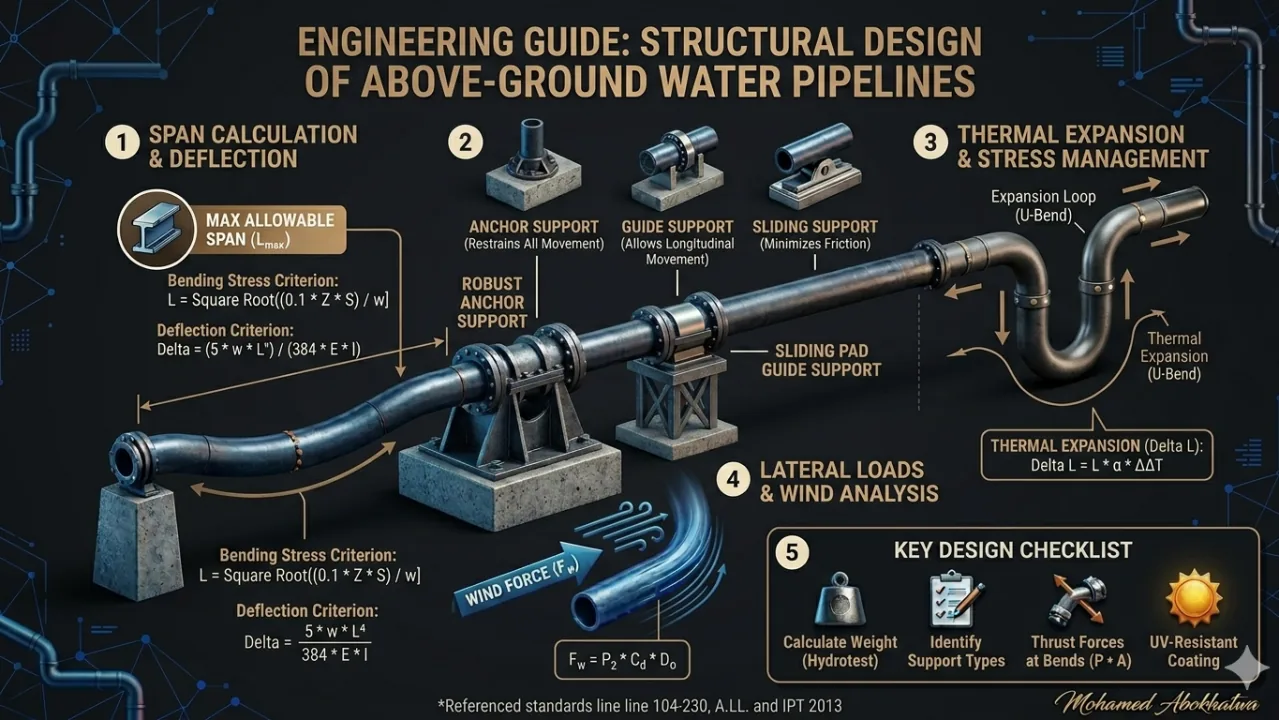
1. Span Calculation: The "Beam" Analogy
The most critical design step is determining the Maximum Allowable Span (Lmax). This is governed by two core engineering criteria.
A. Bending Stress Criterion
The design ensures the pipe does not exceed its allowable material stress (S).
B. Deflection Criterion
To prevent "pocketing," vertical deflection (Δ) is usually limited to L/500 or a maximum of 25 mm.
2. Thermal Expansion & Stress Management
Temperature changes cause linear expansion that must be absorbed to prevent buckling.
Design Solutions
- Expansion Loops: Utilizing 90-degree bends to absorb movement
- Expansion Joints: Mechanical bellows used in tight spaces
- Anchors & Guides: Anchors lock the pipe to direct expansion; Guides ensure movement remains longitudinal
3. Lateral Loads: Wind & Seismic
Above-ground pipes act as a sail, and lateral stability must be checked.
4. Material Comparison
| Material | Span Capability | Thermal Expansion | UV Resistance |
|---|---|---|---|
| Steel (API 5L) | Very High | Moderate | Requires Coating |
| Ductile Iron | Medium | Low | High |
| GRP / Fiberglass | Low (more supports needed) | High | Requires UV-inhibitor resin |
5. Design Checklist
- Calculate Weight: Always use the "Hydrotest" weight (pipe 100% full of water)
- Support Types: Place Anchors at direction changes and Guides at 1/4 span intervals
- Thrust Forces: Design supports for (Pressure × Area) forces at all bends
- Coating: Specify a UV-resistant Aliphatic Polyurethane topcoat
References
- ASME B31.3: Process Piping (Stress analysis)
- AWWA M11: Steel Pipe Design and Installation
- ASCE 7: Minimum Design Loads (Wind and Seismic)
- MSS SP-58: Pipe Hangers and Supports Standards